The Five Transformations: A Conversation with Corinne Senechal, LAc on Peonies – Life Cycles
Corinne and I met at a meditation course we were both attending. In conversation one day, she told me she loved Peonies – Life Cycles and wanted a custom print made for her office. When I asked what spoke to her in the painting, she began telling me about the Chinese medicine cycle of transformations — that for her, the painting is an embodiment of the full cycle. It was such a unique and beautiful way of seeing the work that I asked if she’d sit down with me to talk about it properly.
There is a particular kind of seeing that comes from years of working with the body’s subtle systems — the kind that notices not just what is beautiful, but what is transforming. When Corinne first saw Peonies – Life Cycles, she didn’t just see flowers at different stages of bloom. She saw the Five Elements of Chinese Medicine, laid out in a single frame.
Corinne is the founder of Dragon Blossom Acupuncture, a practice blending Japanese acupuncture, Chinese herbal medicine, and energy healing, now based in a new office in Novato, CA. What follows is our conversation about what she sees in the painting, the space she’s building, and the philosophy that shapes it.
A Conversation With the Body
Before we ever got to the painting, what stood out most to me was how Corinne described a session itself. She has a unique style that blends Japanese Hara diagnosis and energetic sensing for an interactive diagnosis and acupuncture treatment. Hara diagnosis is palpating the client’s abdomen to identify areas of tenderness that indicate underlying imbalances. She then locates the acupuncture points that reduce the tenderness and incorporates those points into the treatment. She’s also reading the client’s energy and finding acupuncture points that create energetic opening and circulation. For example, if a client has chest tension, she finds a point that will best open their chest and help them feel relaxed.
“Each session is a conversation with the body.”
It’s not a purely theoretical diagnosis; it’s a back-and-forth interaction where she finds the points that shift the client’s symptoms while she’s working on them. She asks her clients what they’re feeling as she works, and she keeps finding and holding points until all the tension releases and everything is flowing again.
What struck me is what that conversation does for the client. Over time, clients start to develop their own inner awareness as well. Working with her, people begin to notice their own chi, to feel how their system responds to an herb or a shift in energy, to sense movement that used to pass by unnoticed. She spoke about this almost as a byproduct of good treatment: more awareness, more agency, and a client who leaves each session a little more fluent in their own body. It’s also, simply, a lot of time and attention. She stays with the client for the whole session, in a way that’s increasingly rare.
She applies the same quality of attention to creating her new clinic and the artwork that she chooses for her space.
Creating a Space for Healing
Before we got to the painting, I wanted to know about her new office, as she’s clearly developing her new space with intention.
The office sits upstairs, tucked among trees, and she wanted it to feel light, open, peaceful, and quiet. A statue of Quan Yin, the bodhisattva of compassion, is on its way in.
It’s a small detail, but a telling one — Corinne talks about her space the way she talks about a patient’s body: as something that holds and moves energy, and deserves to be tended accordingly.
Art as Noetic Insight
I asked Corinne what she means when she says that Peonies carries Chinese medicine qualities, and how that’s different from art simply being calming or beautiful.
Her answer went straight to the heart of how she practices medicine. She talked about noetic insight — an “aha” realization and understanding at a deep level. From her training, she’s gained her own noetic insight around the body, cycles of transformation, and the nature of life that she applies in her treatment. She’s also sharing this insight with her clients so they can understand the process of their own healing.
For Corinne, that understanding drives the treatment. She’s constantly checking in with clients during sessions: What are you feeling, right now, in your body? Does it change when I hold these points?
Art, in her view, can do something similar. It can hand someone an insight before they even have the words for it.
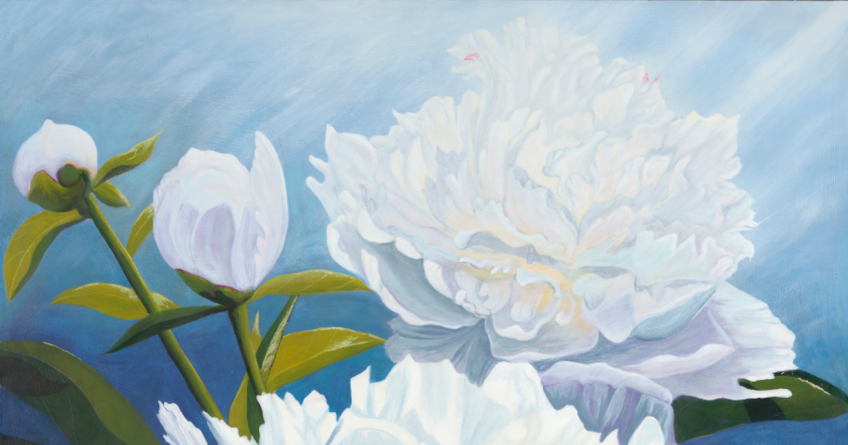
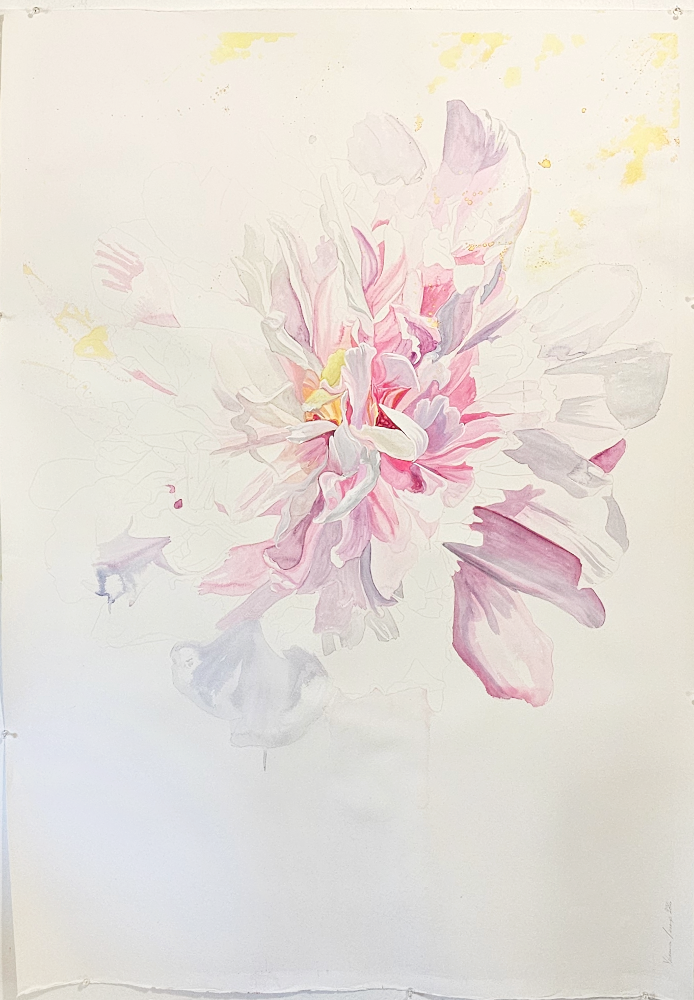
The buds and early blossom: Wood phase symbolizing spring, youth, early morning.
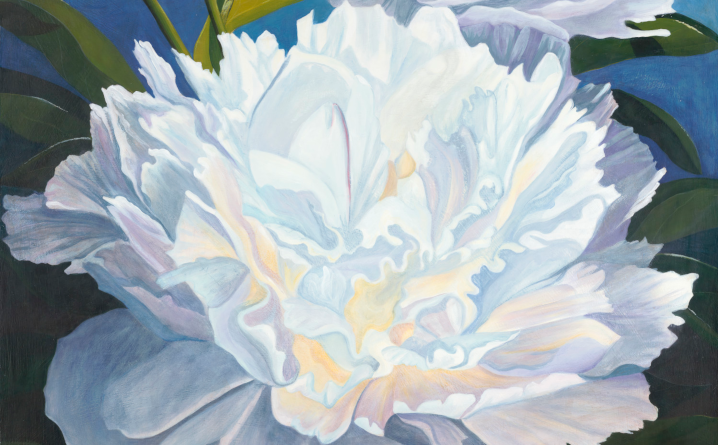
The central bloom symbolizing fire phase: fullness of expression, creativity, summer.
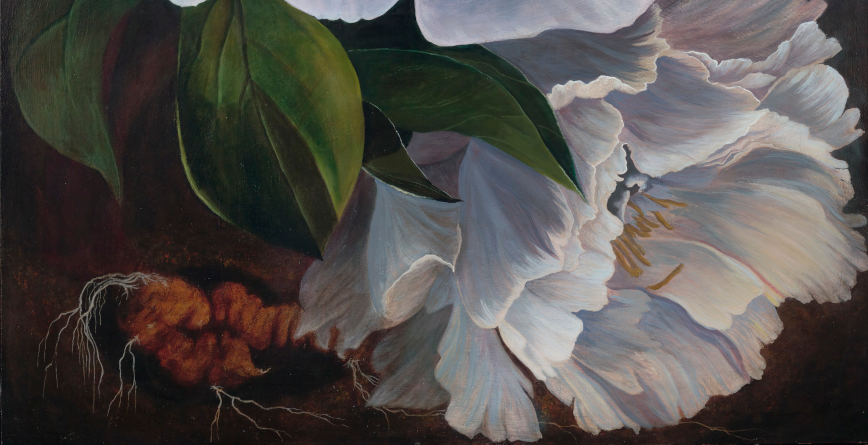
Dying flower symbolizing the metal phase: autumn, letting go, refinement.
Roots at the bottom representing the water phase: winter, composting, return to source.
The Five Transformations in Peonies – Life Cycles
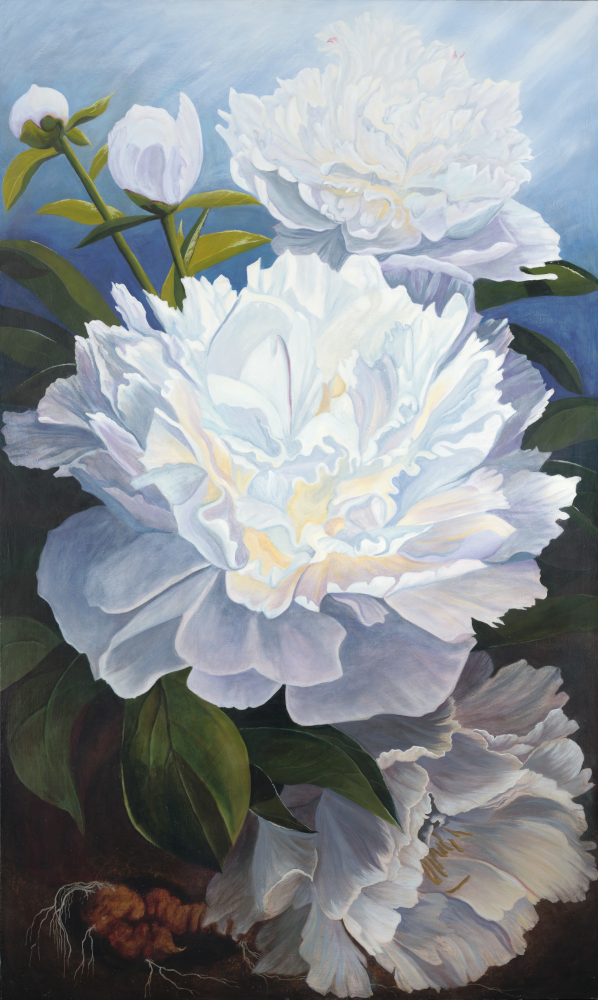
I asked Corinne to walk me through what she actually sees in the painting. “It’s the five transformations, which are more commonly known as the five elements,” she told me. She explained how all vital substances (elements) cycle through various phases of transformation. Yin and yang continuously adjust to one another and transform into one another in a never-ending dance of harmonization.
In both Chinese philosophy and medicine, these stages of yin-yang transformation are referred to as the wu xing, the “five phases of transformation.”
The small buds reaching upward, toward the sun, are a new beginning representing the Wood phase. Wood is spring, youth, and early morning.
She lingered on the central bloom, the largest and brightest. “I love the one in the middle,” she said. “It’s the biggest, shining. I love the colors.” This one represents the Fire phase — fullness of expression, creativity, and summer.
And she lingered, too, on the lowest flower, the one letting go. In the Chinese medicine perspective, that’s not a loss to resist — it’s a flower being allowed to release, to return to its source element. This is the Metal phase, representing autumn, letting go, and refinement.
The roots at the bottom are the Water phase. They represent winter, life under the ground, and a return or reconnecting to the source.
The transition between each phase is Earth. It’s digestion, integration, and taking lessons from the previous phase into the next one. It also represents late summer, nourishment, and enjoying what you’ve accomplished.
At the heart of it all is yin and yang, continuously transforming into each other — like day turning into night.
“Things do not stay the same,” she said. “Everything is continually transforming.” Life opens and expands during the day and in the summer, then goes down and rests in the night and winter. If yang doesn’t fully descend in winter, she noted, it can’t rise again in spring.
And this isn’t only happening in the seasons, she pointed out — it’s happening in the body too. The liver energetically reaches up. The lung moves down. The sympathetic nervous system turns on when it needs to go into fight or flight, and the parasympathetic when it’s time to rest and digest.
Illness, in this framework, is what happens when something stops transforming.
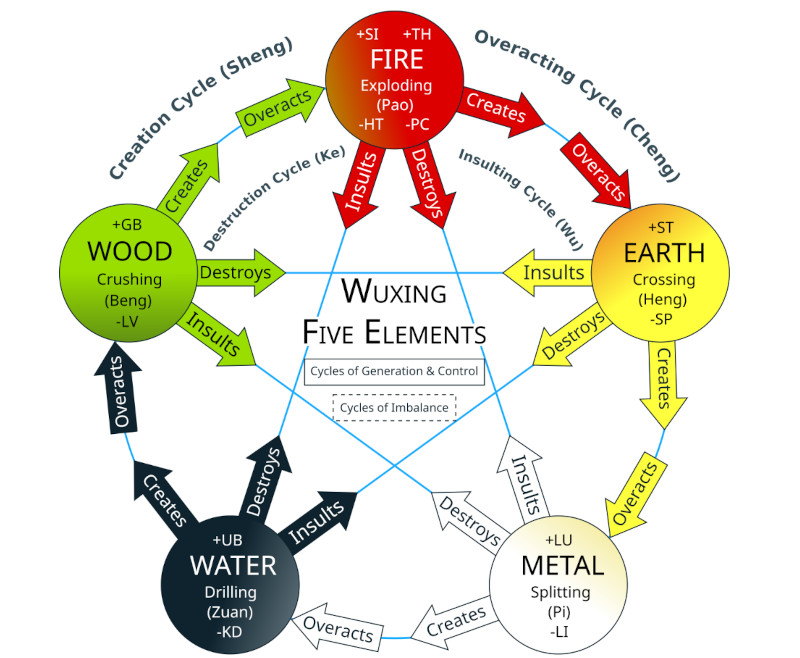
Diagram: Wuxing – Five Elements – Cycle Balance Imbalance by Jim McKeeth, via Wikimedia Commons, CC BY-SA 4.0.
Original image by Manonastreet.
The Elements in Relationship
Once we’d located where each element lived in the piece, Corinne pointed out that they don’t just sit side by side in the painting — they act on each other, generating and restraining one another, the way organs and emotions do in a body.
In the generating cycle, each element feeds the next: Wood feeds Fire (a strong Wood makes for a strong Fire), and so on around the wheel. Each element is the “mother” of the one that follows. In the controlling cycle, elements check each other: Metal controls Wood (like pruning), Wood controls Earth (roots holding soil), Earth controls Water (a riverbed shaping a river), Water controls Fire.
When a controlling relationship overcorrects, she explained, you get stagnation — Wood over-controlling Earth, for instance, shows up clinically as unresolved stress affecting digestion. It’s a vivid, embodied way of understanding why an imbalance in one area of life so often shows up somewhere else entirely.
Can Art Actually Support an Element That’s Missing?
I asked Corinne whether people tend to run short on a particular element — and whether art could genuinely help address that, the way an herbal formula might.
She answered with a case from her own practice: a client whose yin and yang were separating. She was becoming too hot in her chest, with a feeling of heat, hyperactivity, and a revved-up nervous system. At the same time, her belly was too cold and sluggish, resulting in bloating and discomfort.
Life, in Chinese medicine and philosophy, is yin and yang intermingling in the body — visible in Hexagram 11, Peace, where yang enters yin. Death is seen as the reverse: yang returns to the sky and yin to the earth, as in Hexagram 12.
What that client needed was to bring yang — warmth and movement — into the belly, and yin — coolness and quiet — into the chest and nervous system. Fire and Water, Heart and Kidney, brought back into relationship.
For someone in that combination of hyperactive, ungrounded, and sluggish states, Corinne said she might recommend an image that brings stillness into the heart, as well as inspiring an embodiment of life.
And sometimes it isn’t about correcting an imbalance so much as making room for a part of someone that isn’t getting expressed. She described another client — living alone, consumed by a demanding job — who has a delicate, refined part of herself that simply doesn’t get much space in her actual life. Corinne’s read: create a place in the home that reflects that part of her.
“I think art can help reflect or draw out of people — a vibe, an energy, or a reflection of the part of themselves they want to bring forward.”
Art works at an emotional and spiritual level, and can be part of the holistic healing process.
Choosing Art With Intention
Toward the end of our conversation, I asked what advice Corinne would give other practitioners setting up their own healing spaces — how to choose art with real intention, rather than simply decorating.
Start with the space you’re creating, she said, and choose art that supports that intention directly. What are you actually trying to communicate? What ideals of health and wellness do you want the art itself to carry? For her, that’s part of why the Quan Yin statue is coming: compassion, made visible.
She circled back to archetypes here — the idea that there’s something behind an image, a kind of spark that works on a person’s consciousness independent of subject matter. Art that simply feels calming is one thing, she said. Art with a spark of nous — insight, intelligence — is another. When a practitioner is working consciously from a set of principles, the art they choose can carry and reinforce those same principles for everyone who walks through the door.
It’s the same instinct, really, that has her checking in with a client’s body point by point until something releases. Whether she’s reading a hara or reading a painting, Corinne is asking the same underlying question: what is actually here, and what does it need to keep moving? A treatment room isn’t so different from a body, in that sense — it’s just another system she’s paying close attention to.
This is the third conversation in an ongoing series exploring how art shapes the spaces where people gather, heal, and reflect — following conversations with Space Clearer and feng shui consultant Tracey Stanton on activating a partnership corner, and Space Clearer Annette Kurtz on choosing art for a home office.
What’s Next for Dragon Blossom Acupuncture
Corinne is currently welcoming new clients into her Novato clinic. Beyond one-on-one sessions, she’s hoping the front room can grow into something more communal — a home for women’s circles, practitioner gatherings, and events, in a downtown she describes warmly.
“The main impulse was to have a really beautiful space for healing to happen,” she told me. She spends real time with each client — researching, puzzling through what a case needs — and she’s increasingly focused on building community with other practitioners in the area.
You can find Corinne and Dragon Blossom Acupuncture at dragonblossomhealing.com or on Instagram @dragon-blossom-healing.
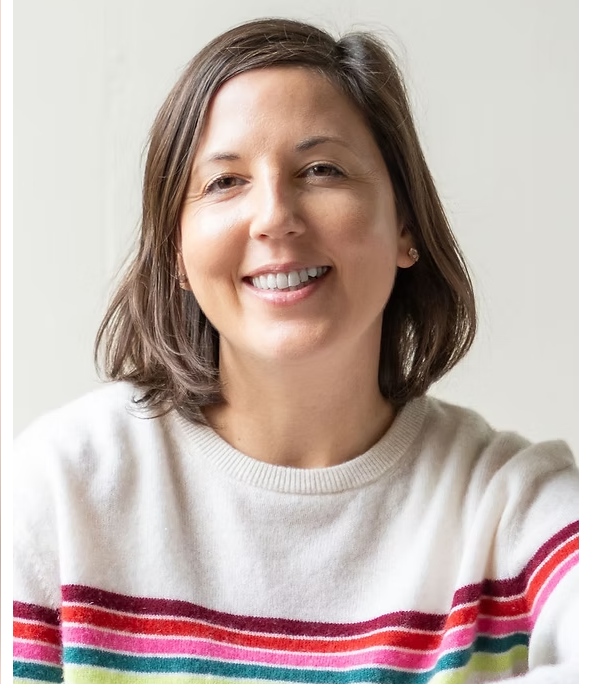
About Corinne Senechal, LAc
Corinne came to Chinese medicine and meditation practice at the same time, and the two have shaped each other ever since — her work treats the body alongside its energetic, emotional, and spiritual dimensions, not apart from them. She has practiced meditation and inner alchemy through the Clairvision School since 2009, training that shapes how she helps clients release long-held patterns and reconnect with deeper parts of themselves — and, in no small part, how she reads a painting like Peonies – Life Cycles.
Her acupuncture style draws on Kiiko Matsumoto’s lineage, rooted in the work of Japanese master Nagano: diagnosis through touch, offering instant feedback to both practitioner and patient. Her herbal training comes from Dr. Heiner Fruehauf, a leading scholar reviving lineage-based Chinese herbal formulas for conditions the modern world is still catching up to — Lyme, autoimmune disease, long COVID, infertility. She has also studied perinatal care with Claudia Citkovitz, former director of the acupuncture program at NYU Langone Hospital–Brooklyn.
A session with Corinne isn’t rushed. She stays with each client for the full appointment, and a visit might include acupuncture, energy healing, moxa, cupping, gua sha, herbal prescriptions, emotional pattern release, and lifestyle guidance — whatever that particular person needs. Her approach treats people as multidimensional beings; she explains that healing which once seemed out of reach often becomes possible when all dimensions are addressed.
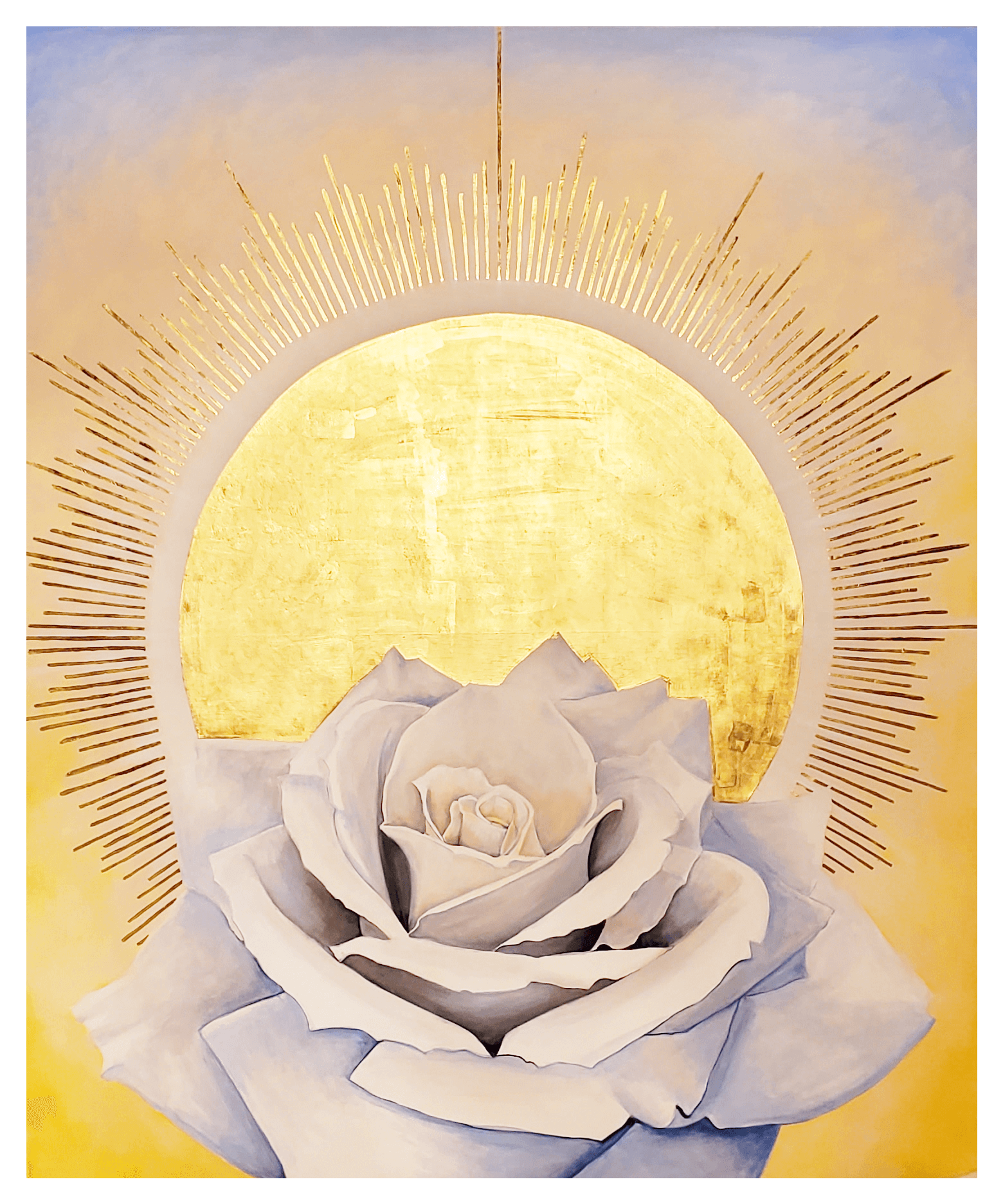
 © Yohanna Jessup - all rights reserved
 © Yohanna Jessup 2026 all rights reserved