
Activating the Partnership Corner: Art, Feng Shui, and the Energy of Relationship
A conversation with Tracey Stanton
There is an area of your home that may be quietly shaping your love life.
In feng shui, this area is known as Kun — the gua representing relationship, marriage, partnership, and receptivity. Depending on which school of feng shui you work with, its location shifts slightly: in the BTB (Black Sect Tantric Buddhism) Bagua, it occupies the far right corner of the home or bedroom; in the Compass School (Li Qi Pai), it sits in the southwest. In both systems, this area is governed by the earth element and associated with the qualities of warmth, receptivity, and connection. What lives here matters — not just energetically, but psychologically. What we place in our intimate spaces tells a story about what we believe is possible for us.
Tracey Stanton is a Space Clearer, emotional healing practitioner, and feng shui consultant who has spent years helping clients transform their spaces — and, in doing so, transform the conditions for love in their lives. I sat down with her recently to ask what she looks for when recommending art for the partnership area, and what she’s witnessed when that space is truly activated.
It Starts with a Longing
When clients come to Tracey specifically about the partnership area of their home, she finds they’re usually refreshingly direct. “Most people who really want partnership say so,” she told me. “They’re quite clear about it.”
That directness is worth honouring. The desire for meaningful partnership — romantic, creative, or otherwise — is one of the most human longings there is. And in feng shui, the spaces we inhabit can either support that longing or subtly work against it.

A pair of horses with rambunctious energy.

A pairing of swans with a gentler, more harmonious space.
What Tracey Looks for First: Pairs
When recommending art for the partnership corner, Tracey’s first criterion is simple: pairs.
“I look for pairs — things that feel harmonious and complementary,” she said. “Two people’s hearts blossoming together.” The energy of the space should reflect the quality of relationship you’re calling in or cultivating. That means the art itself needs to embody what you want the partnership to feel like.
This goes deeper than simply finding two objects. She once worked with a client who had a pair of galloping horses in their love corner. “They were beautiful, but too rambunctious,” Tracey recalled. “The energy was all momentum and doing. There wasn’t much stillness. And that did show up in their relationship — lots of activity, not a lot of quiet time together.”
The quality of the pairing matters as much as the fact of it.
Color, Element, and What to Avoid
In feng shui, the relationship area is governed by the earth element, with fire as a supportive influence. Warm, soft palettes — whites, pinks, earth tones, gentle corals — tend to work beautifully here. For the bedroom specifically, Tracey recommends weaving activating colors like pink or red into soft furnishings — pillows, textiles — rather than large wall pieces. “You want some of these colors to keep passion alive,” she explained, “but you don’t want to overdo it, or you won’t sleep.” The art itself can afford to be quieter, holding warmth without intensity.
What she steers clients away from: gray (metal energy that drains the earth element) and strong blues and black (water element makes earth muddy). “A little gold won’t hurt,” she added — a note that feels relevant given the gold leaf present in several of my own paintings.
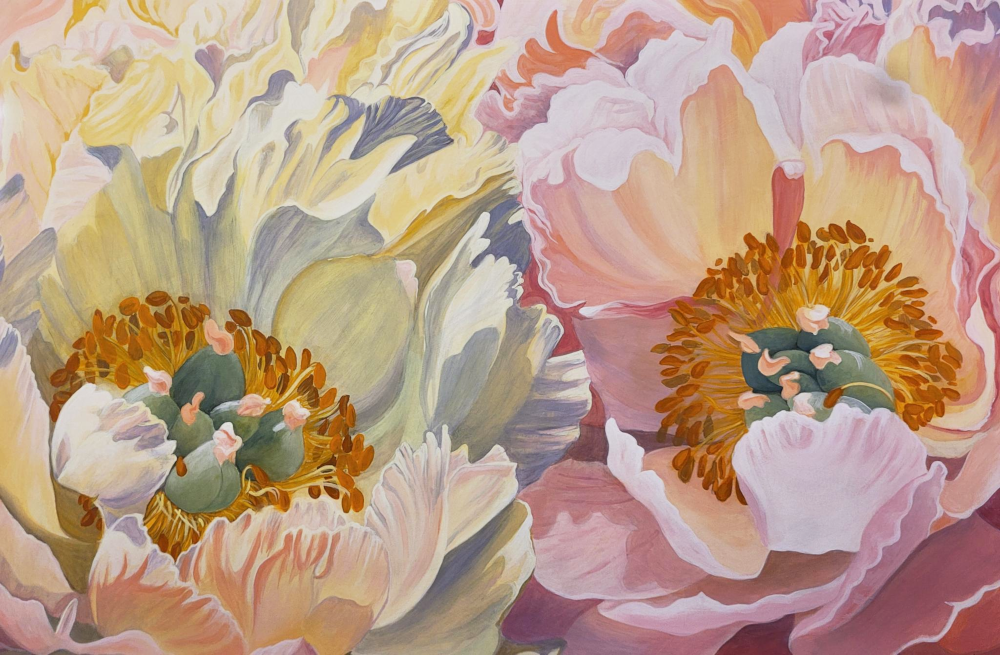
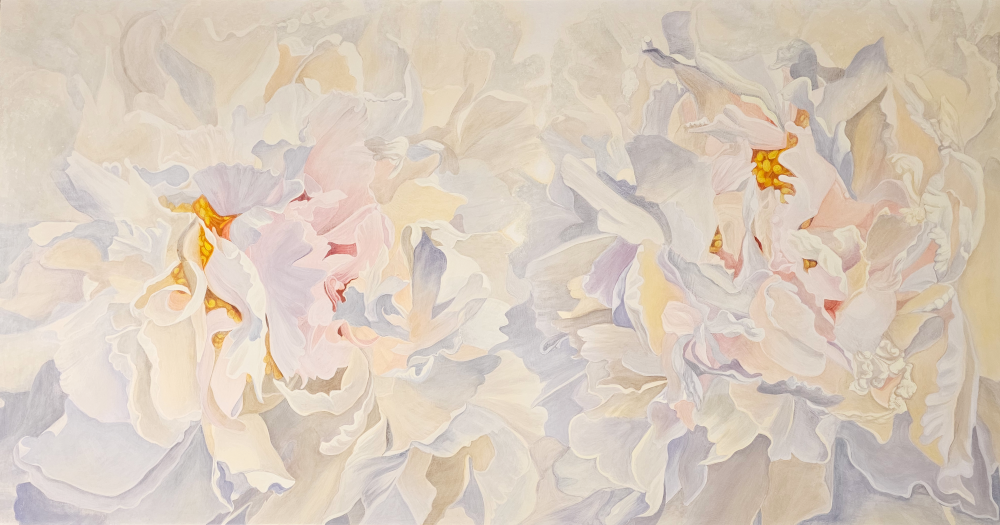
Peonies (Union) painting – a soft, sensual, aspirational energy for pairing.
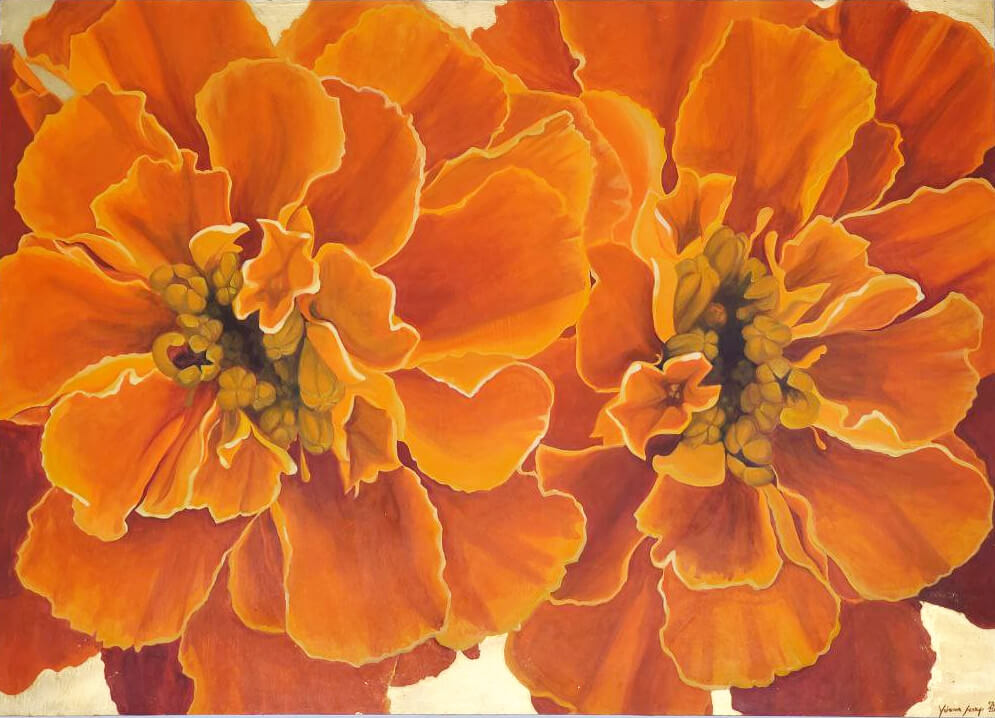
Marigolds painting embodies warmth and creative dynamism it it’s pairing.
Flowers, and Why Peonies Hold a Special Place
Flowers are among Tracey’s favourite recommendations for the partnership corner — and for good reason. “They’re beautiful because of what they represent: blossoming. Two people’s hearts opening toward each other.”
In the Chinese tradition, the peony is considered the king of flowers and is intimately associated with love, romance, and marriage. “It’s a very traditional feng shui choice,” Tracey said of my Peonies (Union) painting. “It’s gorgeous, sensual, full of life. I love that the two blooms aren’t identical — the colors differ, which gives it a quality of two distinct beings coming together.” She noted that the yellow in the piece is an earth color that complements the relationship area well, and carries an association with health — a welcome secondary quality. The traditional colors for this area are pinks and whites, both of which are present in the painting’s palette.
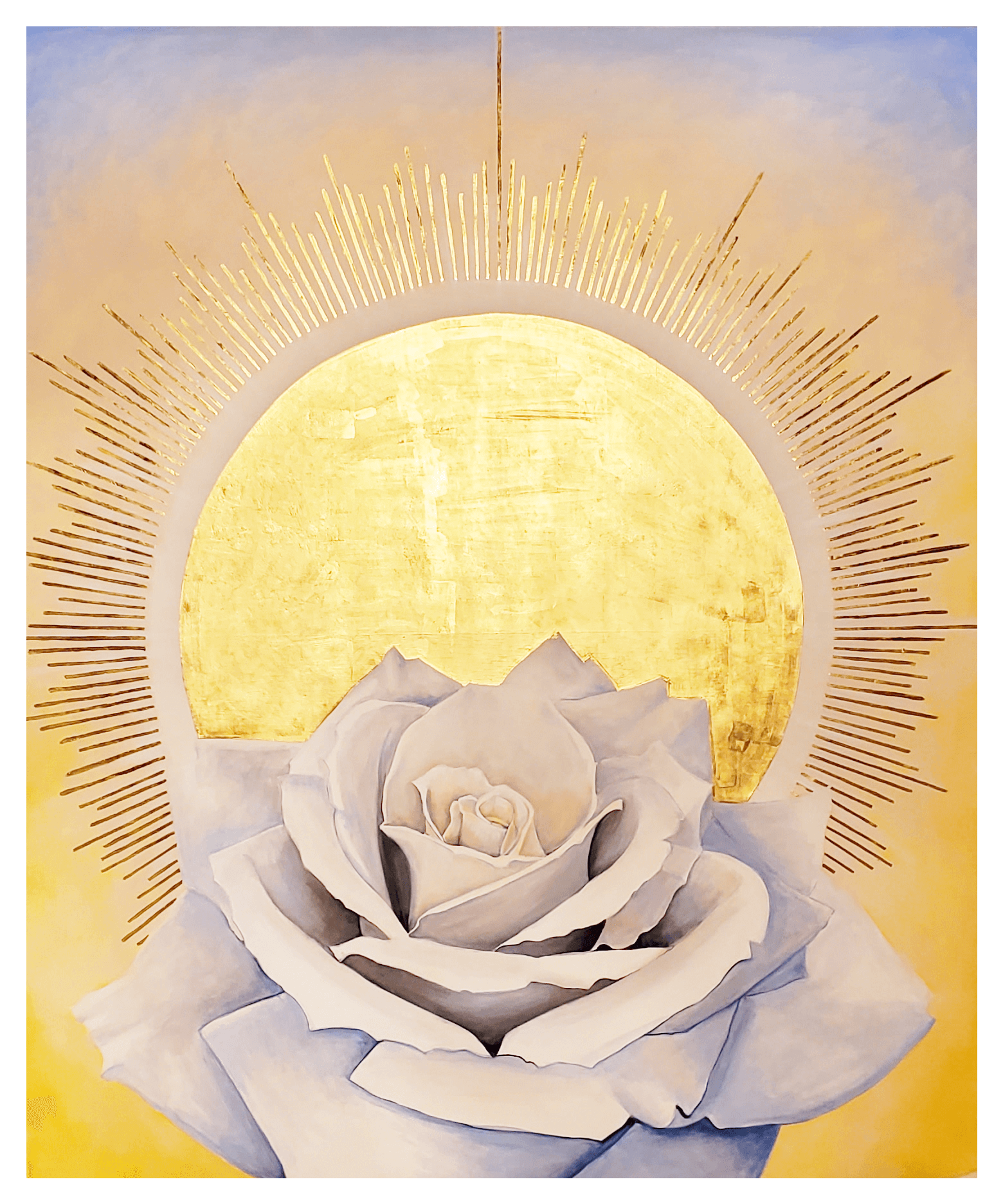
The rose, too, carries a particular purity. A pair of roses — especially in white and pink — would be a strong choice for this space. One thing to be mindful of: avoid images that show thorns, as their spikiness can activate what feng shui calls a “poison arrow” quality. What you want is the heart of the rose — the delicate, unfurling center, soft and open.
Marigolds is another painting that will enhance the partnership area. It brings a sense of warmth, movement, and relational energy into a space — a piece that tends to enliven its surroundings and subtly activate the field between people within it.
A Special Note on the Bedroom
While the Kun area of the broader home is the classical relationship corner, Tracey was clear that the bedroom itself deserves equal attention.
“The bedroom is your most intimate place,” she said. “I think activating the love corner within the bedroom is as important as the relationship corner of the broader bagua.”
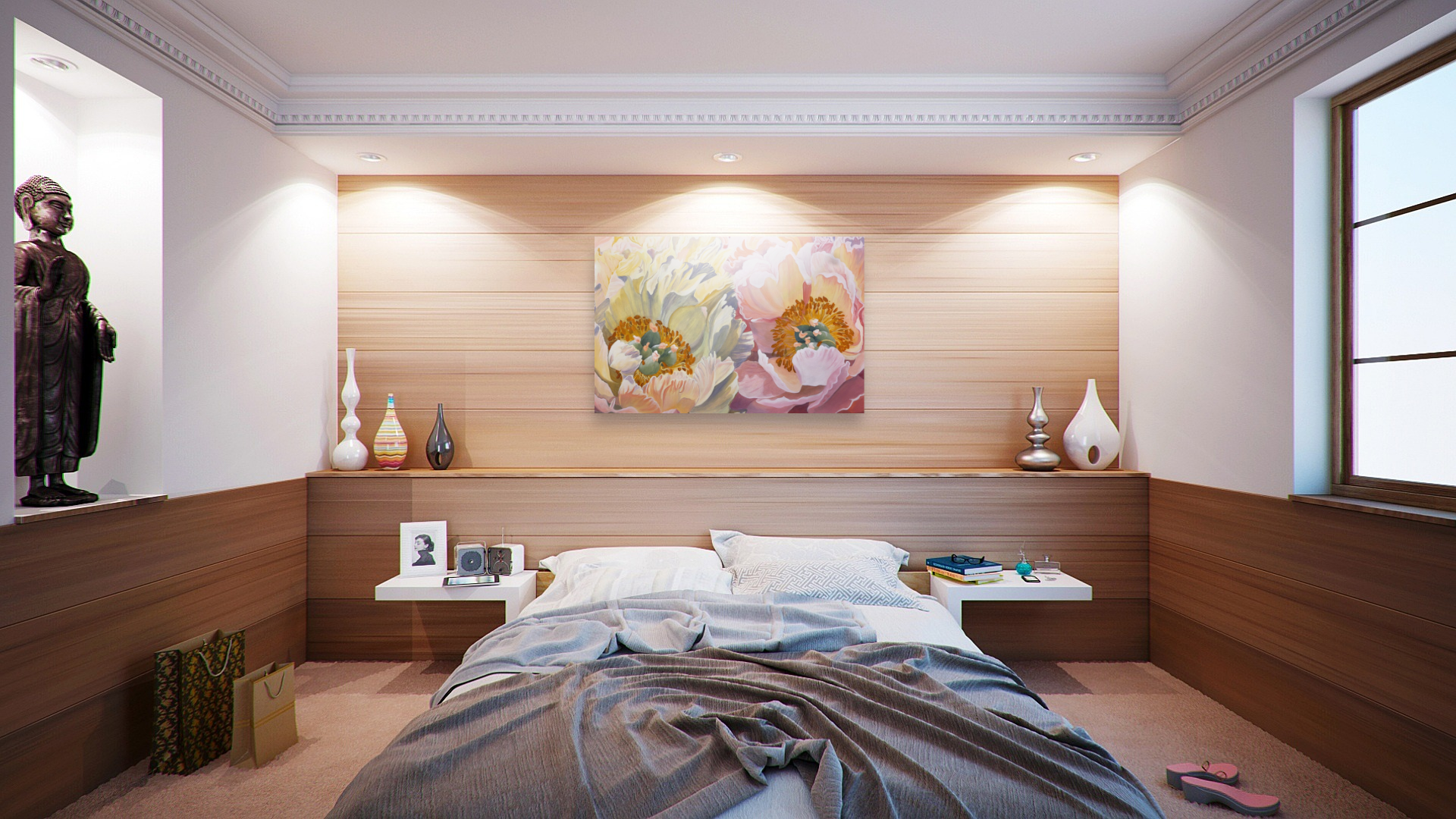
But the bedroom calls for a different quality of art than you might choose elsewhere. Because it is a space for rest, rejuvenation, and deep connection, what you place there needs to carry a certain quietude — a softness and intimacy that allows you to truly come to rest. “You want a place to rest your chi at night,” Tracey explained. Art in the bedroom should feel like an exhale: still, warm, and gently alive rather than activating or dynamic.
Soft pairings in muted, warm tones. Flowers that feel open rather than energetically busy. Images of birds or animals in harmonious pairs can also work beautifully here — anything that evokes connection and ease rather than movement and intensity.
What Makes Art Truly Activate a Space
This is the question at the heart of it all: what separates art that decorates from art that actually shifts the energy of a space?
For Tracey, it comes down to two things: how it feels, and what it symbolizes.
“The sensations in the body are really important,” she told me. “Not just the mental idea or the concept.” If you stand in front of a piece and something in you closes rather than opens — if it feels heavy, unbalanced, or somehow painful — it doesn’t belong in your love corner, regardless of what it depicts.
And then there’s what she called the quality of presence. “Some art really creates a space. It makes the room. The room orients around it.” When a painting carries genuine presence — when it uplifts you, when it feels alive — it becomes more than decoration. It becomes an anchor for the energy you want to inhabit.
She also raised something quietly profound: the energy of the maker matters. “You’ve got to like the person who painted it, and you want them to be holding a great space while they’re working.” The consciousness brought to the act of creation becomes part of what the finished work holds.
Stories That Stayed With Me
Tracey shared a few client stories that illustrate what becomes possible when the partnership area is genuinely activated.
After a space clearing, a client in San Francisco noticed something she hadn’t seen clearly before: the painting in her partnership area showed one figure turned away from the other. Symbolically, she was living with the image of a partner facing away — an inharmonious pairing. She removed it and brought in art that felt lighter, sweeter, and more genuinely paired. A month later, she met a partner.
Over many years in her practice, Tracey has walked into homes of women who wanted partnership but had filled every wall with single female imagery. “In order to attract a partner,” she would tell them, “you’re going to have to let go of about 70% of this.” One client did exactly that — clearing out the solitary figures and bringing in paired images with a balance of masculine and feminine energy. She soon reconnected with her high school sweetheart. They are still together today, fifteen years on.
The last story is the one I keep returning to.
A client commissioned a painting specifically for her love corner, intending it to call in a new partner. The day the painting was completed was the same day she met her future husband.
“With a commission, it’s especially powerful,” Tracey explained, “because the qualities you want in a partnership can be the very qualities the artist represents or imbues into the painting. The symbolism, the colors, the imagery — all of it can be tailored to reflect what you genuinely want. And that is immensely powerful.”
What This Means If You’re Ready
If you’ve been thinking about the partnership area of your home — whether you’re calling in a new relationship, deepening an existing one, or simply wanting your intimate spaces to feel more alive — there are a few places to begin.
Start by noticing what’s already there. Are there images of solitude where you want companionship? Imbalance where you want harmony? Are objects placed in singles where pairs would serve better? And beyond the walls — is there room in the closet for another person’s things? Creating space, literally and symbolically, is often the first act.
Then ask what you want to invite in. Not just the relationship, but the quality of it. The feeling of it. The art you choose for that corner can be an expression of what you’re ready to receive.
A commissioned painting, created with specific intention, is one of the most direct ways to do this. If that feels like the right next step, I’d love to have a conversation about what that might look like for you.
Work with Tracey Stanton
If this conversation has you thinking about your own space — what it’s holding, what it might be ready to release — Tracey Stanton works with clients as a Space Clearer, emotional healing practitioner, and founder of The Flow of Love. With 24 years of experience and more than 1,000 home and business space clearings, she brings both deep knowledge and a grounded, compassionate approach to creating spaces that support what you most want in life.
Whether you’re navigating a transition such as divorce or separation, beginning again after loss or heartbreak, or simply sensing that your home is ready for a reset, a space clearing or feng shui consultation with Tracey can be a powerful catalyst — something that doesn’t just shift the room, but shifts what becomes possible in it.
Tracey Stanton is a Space Clearer, Emotional Healing practitioner, and founder of The Flow of Love, working with private clients on creating spaces — and lives — that reflect what they most deeply want.
 © Yohanna Jessup all rights reserved