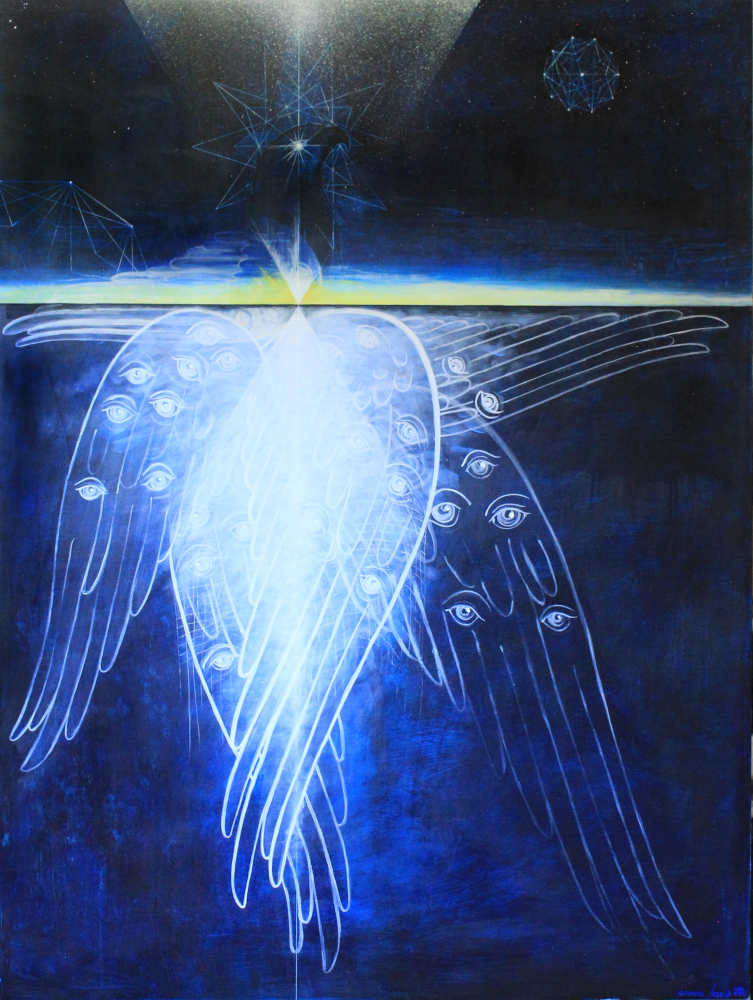
Aquila: A Painting of Threshold and Ascent
AQUILA
36 x 48 x 2 inches
Water soluble wax paint on wood panel
Available $5,200
There is a particular quality of silence that comes with snow. I woke to it on the first morning of a week-long silent meditation retreat in a remote part of Northern California, spanning the last days of the old year into the first of the new — the region under a fresh white blanket, the whole world muffled into a kind of magical hush. Winter is, I think, one of the best seasons for meditation. The natural momentum of the season is already turning inward, and the silence outside makes it easier to find the silence within.
Aquila began during that week, though it would take shape over the following months, and become finalized this past week. It is a painting about moving through layers of consciousness — about how awareness can condense and refine as it passes through threshold after threshold, toward a deeper and deeper silence. It is also about moving from a fluid-dimensional state into states of lesser dimensionality — states where the same knowing becomes more densely packed, more distilled. The visual movement of the piece follows that same trajectory: it begins in the lower three-quarters of the panel and rises, crossing a threshold, into the qualities of refined lines, geometric forms and light from above.
The Night Sky and the Eagle Overhead
Each evening after a day of sitting, I walked back to my lodging beneath extraordinarily clear winter skies. Every night, low in the southwest, the constellation Aquila — the Eagle — was setting. Aquila takes its name from the Latin word for eagle, and in Greek mythology it is identified as the eagle that carried the thunderbolts of Zeus. Its brightest star, Altair, forms one point of the Summer Triangle — visible from the Northern Hemisphere in the warmer months, and by winter, low and departing, as it was for me that week.
A Presence in a Garment of Light
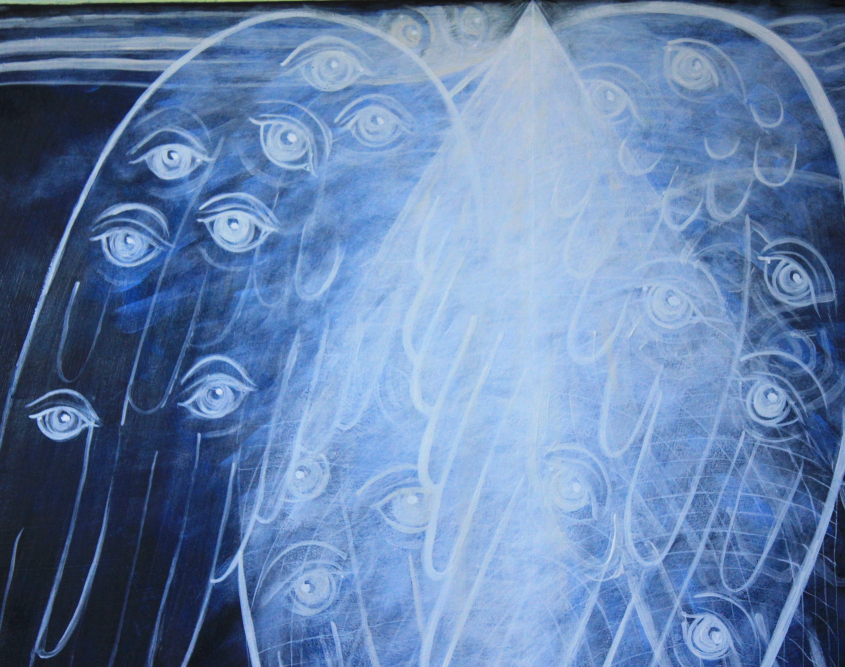
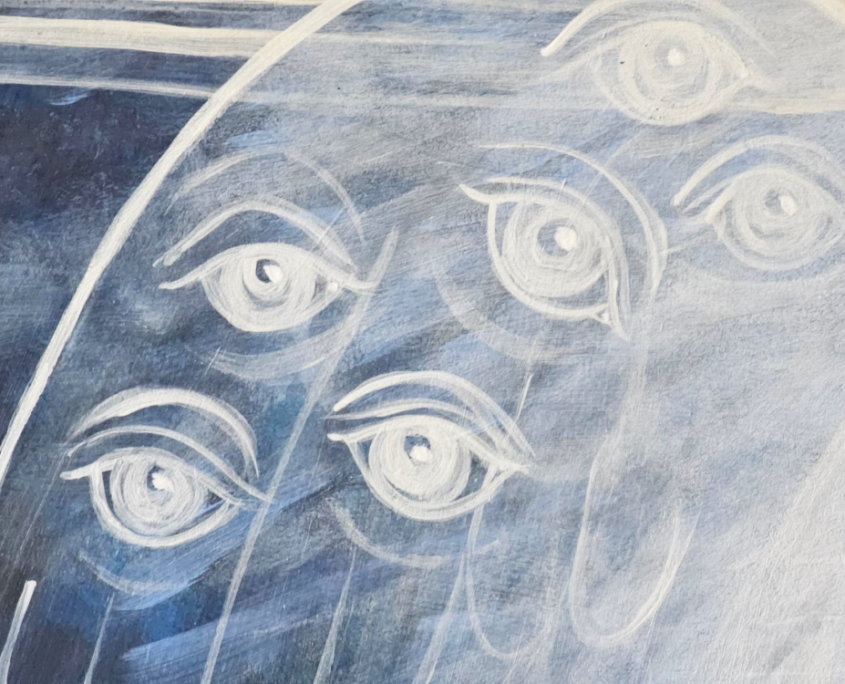
During one round of meditation, something met me. I won’t try to tell you exactly what it was — I’m not sure that’s mine to resolve, or even necessary. What I can tell you is how it appeared: not visually solid, but wrapped in what I can only describe as a garment of light. Samuel Sagan, in Awakening the Third Eye, writes about this quality of the astral worlds: that in those realms light doesn’t originate from any external source like a sun or a lamp, but from the luminosity of the beings and objects themselves — as though everything were made of color, glowing softly within a kind of semi-darkness (p. 69). That description matches almost exactly what I encountered.
This “garment of light” is symbolized by the wings with eyes in the lower two-thirds of the painting. This imagery has old roots in early Christian iconography. It echoes ancient depictions of seraphim, cherubim, and thrones — different beings in angelic hierarchies — and their all-seeing, spiritual vision.
As I stayed with the presence, my own consciousness began to refine, resonating more closely with it, and I felt myself drawn toward a higher, more concentrated state. That transition is marked in the painting by a small, singular white dot suspended above the triangle of light, just under the horizon line. It is a resting point — a place where focus gathers and consciousness begins to internalize rather than reach outward. Above it, the horizontal bands of color — yellow shifting into aqua blue — are the felt experience of passing through that threshold: layer after layer, expanding, until arriving at a very refined state of clarity and stillness. A beautiful state of fullness and clarity, bright with awakening.
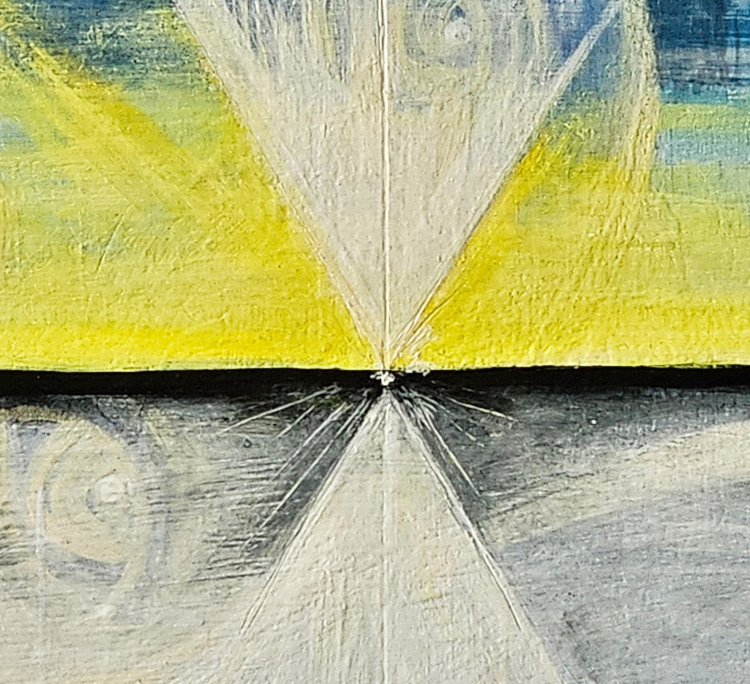
The Threshold
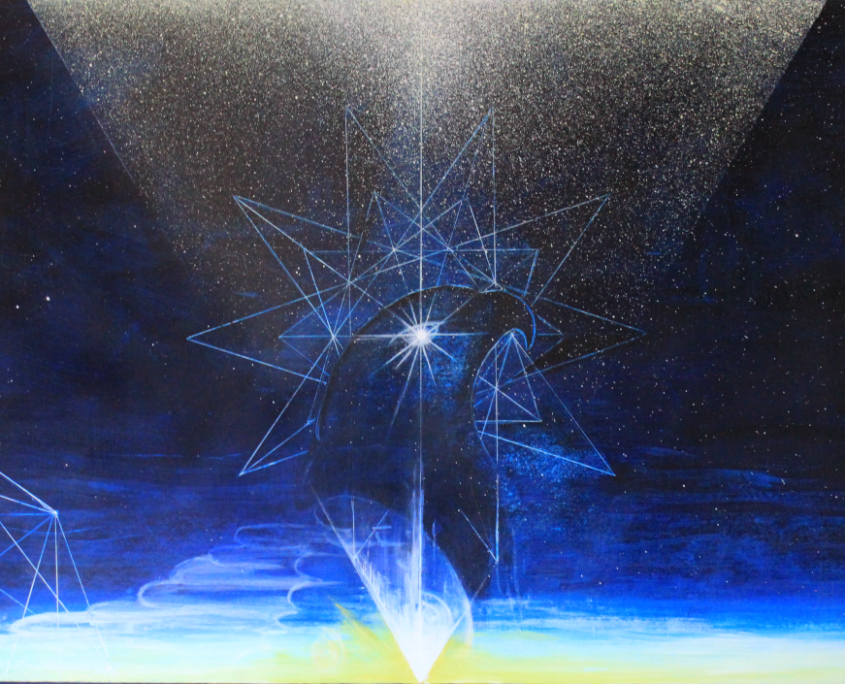
On the other side of that threshold, the qualities of presence changed shape again — or rather, stopped needing a shape at all. It became less visual — less a sense of light or form — and more a felt quality: intricate geometry, immense speed, deep clarity, a sweeping and total vision. The eagle’s head at the top of the painting is a symbolic nod to exactly that — the eagle’s traditional qualities of vision and clarity, flying high enough to see everything at once. And the emphasis on the eye, throughout the wings and at the head, points to that same quality of “seeingness” — an aspect of consciousness that sometimes arrives as pure visual sight, but just as often arrives simply as knowing.
This became the seed for the upper third of the painting. There, I used etching tools instead of a brush, cutting refined lines and geometric forms into the surface rather than laying down paint with the softness of a brushstroke. The precision felt right for what that part of the painting needed to hold: the beautiful, almost mathematical clarity of the winter night sky, but also the quality of luminous, packed silence and presence I was finding in meditation itself — a state where knowing no longer needs to unfold in time, but is simply present. Whole.
The geometry in this section also represents archetypal realms, so the other geometric shapes can be read as encounters with other beings, archetypes, or “packed thoughts” — something far broader and denser than what ordinary human consciousness experiences as a thought. It is less an image and more a luminous, archetypal knowing.
This top third of the painting is where the real action is, even though it is visually the quietest part of the piece — you have to come close to the panel to see what’s happening in the detail. I like that quality. It mirrors what it depicts: the drawing-in of consciousness, and the reality of states that are more packed, more internalized, than anything visually loud could hold.
The Eagle as an Ancient Symbol of Vision
The eagle carries this symbolism across an unusually wide range of traditions, which is part of why it felt like the right form for this experience.
In the Hebrew scriptures, the eagle is one of four faces belonging to the cherubim in Ezekiel’s visions — alongside a man, a lion, and an ox — each representing the widest reach of creation, with the eagle’s face standing for height, speed, and penetrating oversight (Ezekiel 1:10, 10:14). The same fourfold imagery reappears in the Book of Revelation, where a flying eagle is again counted among the four living creatures surrounding the throne (Revelation 4:7).
That same fourfold tradition became, in early Christian art, the symbols of the four Gospel writers — and the eagle was given to John. Augustine, writing about the Gospel of John in the fifth century, put the distinction memorably: where the other three evangelists stay grounded, walking through the earthly life of Christ, John’s Gospel seems to lift off entirely, soaring above the clouds toward a more direct vision of eternal light. Jerome, working through the same fourfold symbolism, affirmed the same pairing on similar grounds — John’s Gospel, more than the others, reaches for the transcendent.
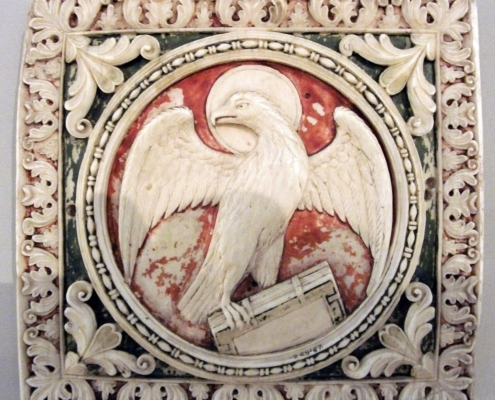
Carolingian ivory, Symbol of St John, V&A Museum. Photo: Johnbod, CC BY-SA 3.0, via Wikimedia Commons.
Medieval bestiaries added another layer still. It was widely believed that an aging eagle, its eyesight dimmed and its feathers heavy, would fly up toward the sun until the mist burned from its eyes, then plunge three times into water and emerge restored — young again, sharp-eyed, renewed. Christian writers folded this directly into the symbolism of baptism: the threefold plunge into water mirrored the threefold baptismal immersion, and the eagle’s return to youth and clarity became an image of the soul’s own renewal. It’s part of why eagles so often appear on baptismal fonts and as the great lecterns that hold the Gospel in old cathedrals — sometimes literally the very stand the sacred text rests on.
In the Clairvision tradition, which has been a seminal influence on my own inner work, the White Eagle appears as a great Angel of Highness — one of two aspects, alongside the White Eagle of the Gods — associated with aspiration, truth, and unconditional love.
Taken together — Ezekiel’s all-seeing cherub, John’s soaring gospel, the bestiary’s renewed and clarified sight, the White Eagle of aspiration — the eagle across these traditions keeps returning to the same core: a vision so elevated it becomes a form of transcendence itself. That is the thread I wanted Aquila to hold.
AQUILA
36 x 48 x 2 inches
Water soluble wax paint on wood panel
Available – $5,200
Started in early 2026, following a week of silent meditation over the winter holidays. Completed in July of 2026.