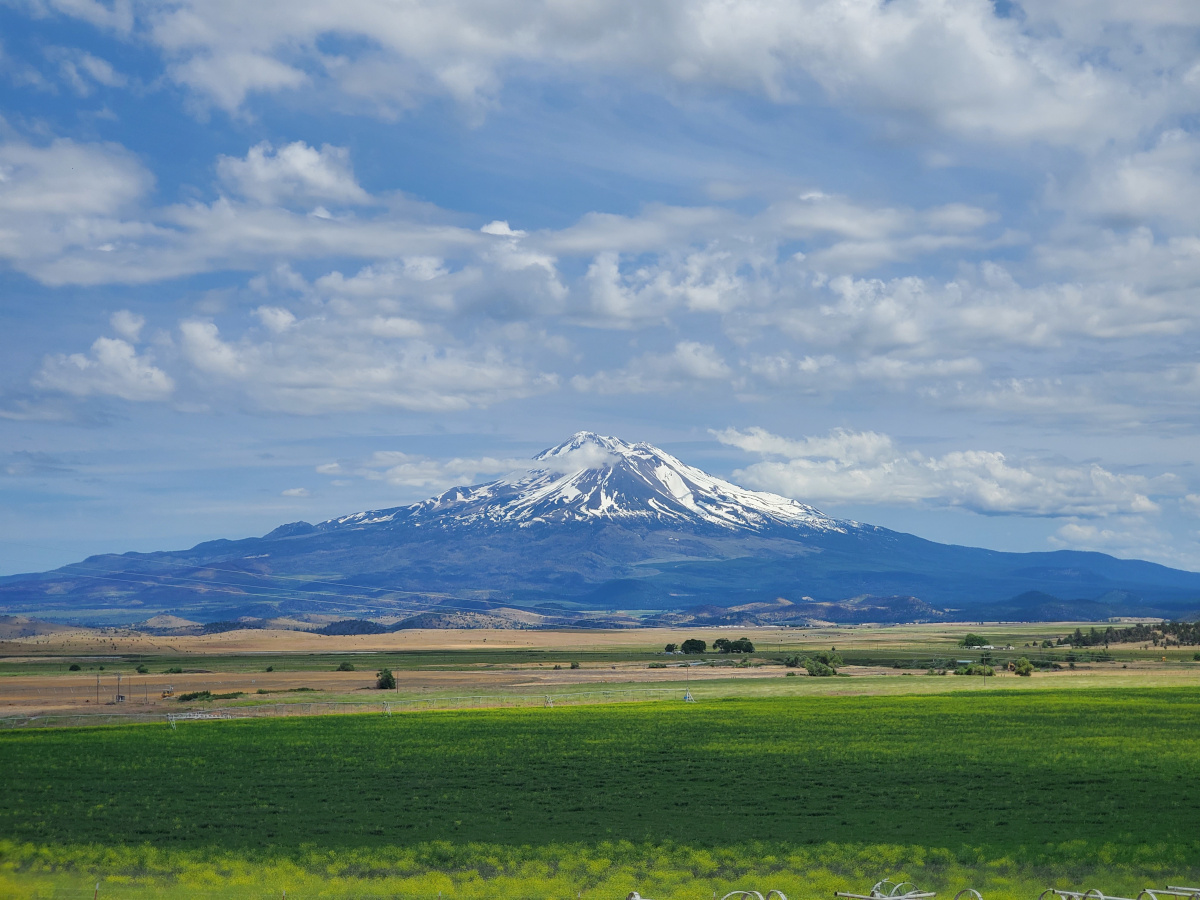
Mount Shasta as seen from the northwest towering above the surrounding volcanic plateau in Northern California

Mount Shasta as seen from the northwest towering above the surrounding volcanic plateau in Northern California
There is a quality of attention that mountains produce that no other landscape quite replicates. It is not simply the scale, though scale is part of it. It is something in the vertical — the way a mountain rises from the horizontal plane of ordinary life and points toward something that the eye cannot follow to its conclusion. You look up. The gaze extends. And at some point the mountain passes beyond what can be clearly seen, into sky, into cloud, into what the Tibetan tradition calls the sky-realm — the dimension that begins where form ends.
This is not a response that requires cultural conditioning. It appears to be universal. Mountain pilgrimage traditions exist in virtually every culture that has had access to significant peaks. Mount Kailash in Tibet. Mount Fuji in Japan. Mount Olympus in Greece. Mount Sinai in the Abrahamic traditions. Mount Meru in Hindu and Buddhist cosmology. The Black Hills of the Lakota. Mount Shasta in Northern California. Across traditions separated by thousands of miles and thousands of years, the mountain occupies the same symbolic position: the place where earth meets sky, where time meets eternity, where the human touches the universal.
There is a name for this position in the history of religions: the axis mundi — the axis of the world.
Understanding what the axis mundi actually is, and why it produces the quality of response it does, illuminates something about why certain landscapes — and certain paintings of landscapes — carry a quality of presence that others do not, whether that painting hangs in a home or in a room where a group of people gather to heal or reflect together.
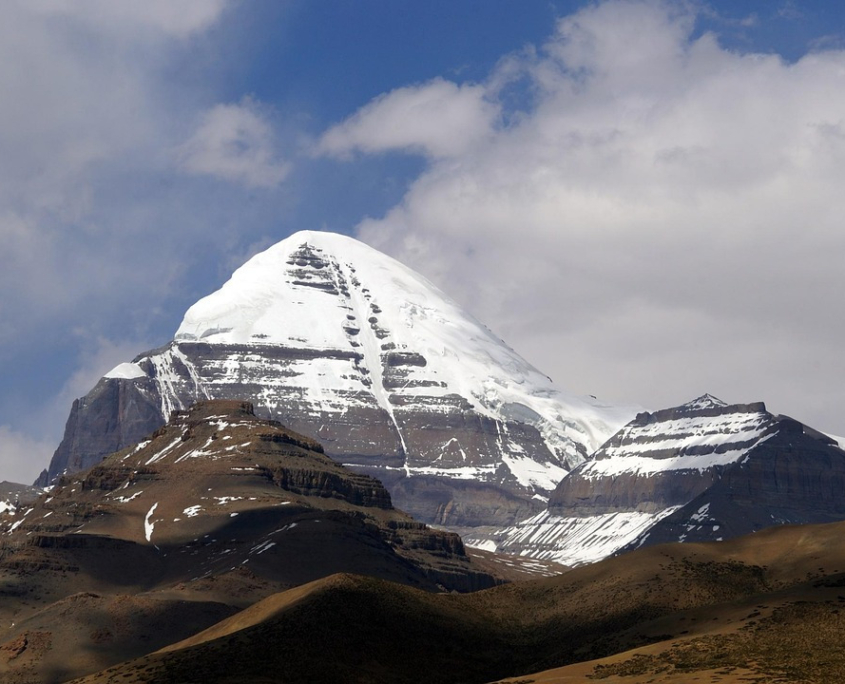
Mount Kailash, Tibet — sacred to four religions, and considered by many to be the physical Mount Meru, the axis mundi at the center of the world.
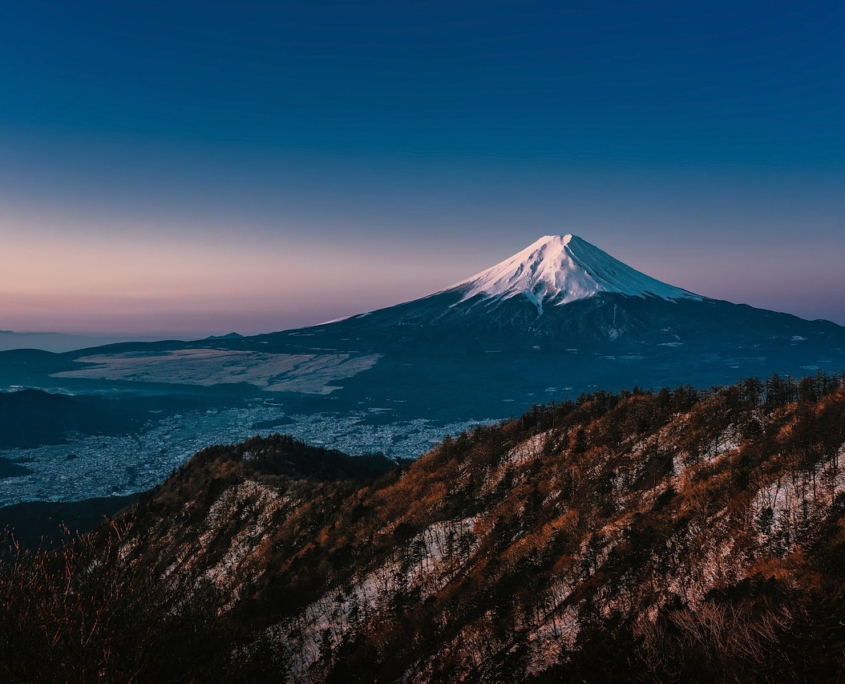
Mount Fuji at twilight — a nearly perfect volcanic cone, and Japan’s most enduring symbol of the sacred vertical.
The term comes from comparative religious studies — it was developed primarily by the Romanian scholar Mircea Eliade in the twentieth century, though the phenomenon it describes is far older than the term.
The axis mundi is the symbolic center of the world: the point or axis around which reality is organised, the bridge between the lower, middle, and upper realms, the place where vertical movement between orders of reality becomes possible. It is not a single fixed location — every tradition has its own version — but a recurring symbolic structure that appears wherever human beings have tried to orient themselves within a cosmos that is larger than the visible.
The axis mundi appears as a mountain, as a world tree (the Norse Yggdrasil, for instance), as a sacred column, as a temple tower, as a cathedral spire, as a stupa, as a ziggurat and the vertical axis of the cross. What all of these share is vertical form: a rise from earth toward sky, a structure that orients the human being along the vertical axis — ground beneath, height above, the individual somewhere in the middle.
What is remarkable is how consistently this symbol recurs across cultures that had no contact with one another. The axis mundi is not a cultural convention borrowed from a common source. It appears to be an expression of something intrinsic to how humans organise experiences of being in a world that has both a horizontal dimension — the plane of ordinary life — and a vertical one, the dimension of height and depth that opens toward something other than the everyday.
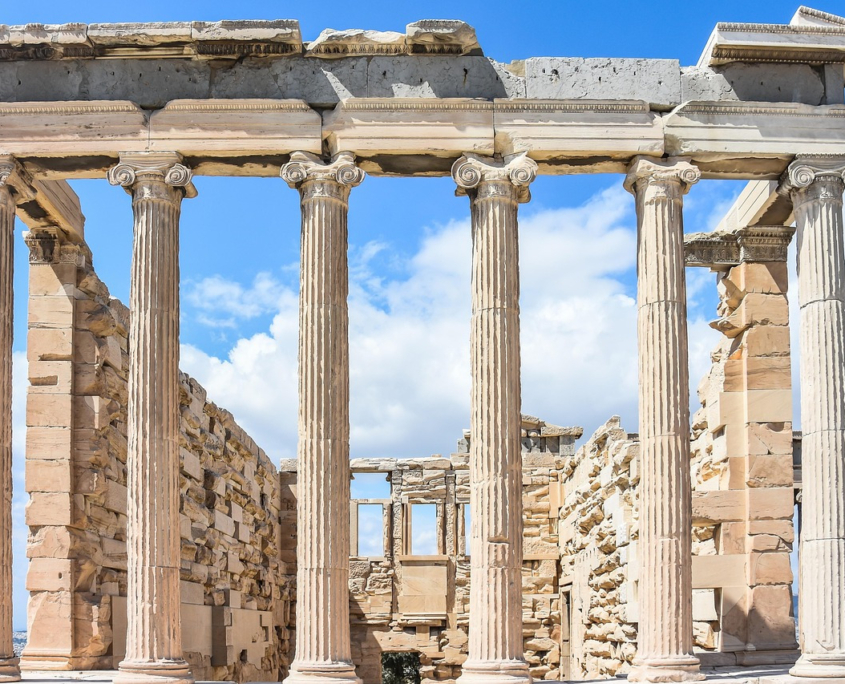
The Erechtheion Acropolis, Athens — vertical form given human proportion, columns lifting the eye the way a summit does.
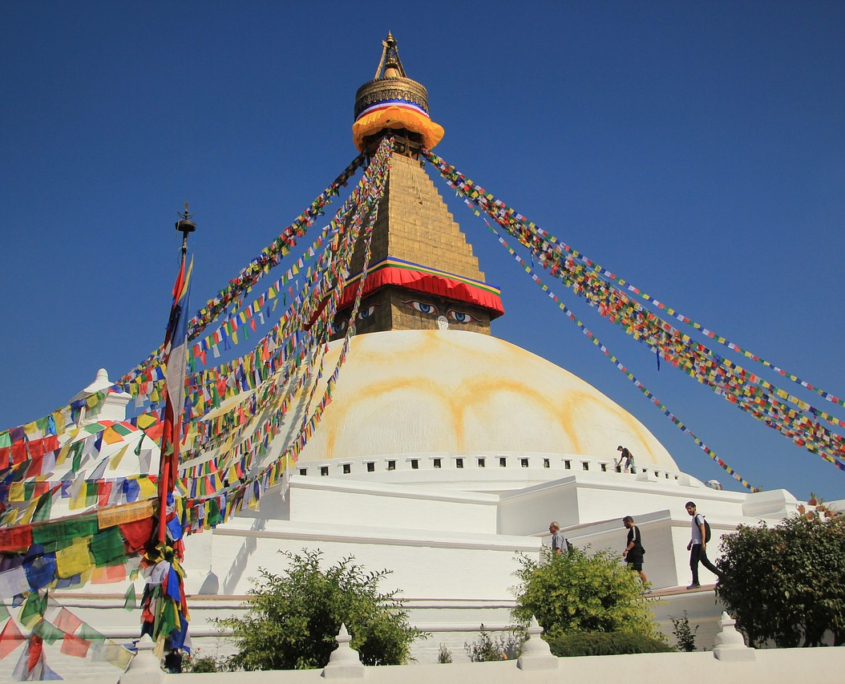
Boudhanath Stupa, Kathmandu — the eyes of the Buddha watching from every direction, and prayer flags carrying the vertical outward on the wind.
There is a body of research in psychology on the experience of awe — that particular quality of response produced by encounters with vastness, with things that exceed our ordinary frameworks of comprehension. The psychologists Dacher Keltner and Jonathan Haidt, whose foundational work on awe has been widely cited, identified two key features of awe-inducing experiences: vastness and accommodation — the need to revise existing mental structures to incorporate what is being experienced.
Mountains produce both. They are vast in a way that cannot be denied. And they require accommodation — the ordinary human sense of scale, of the self as the primary reference point, must be temporarily suspended in their presence. This suspension, Keltner and Haidt found, is not merely humbling. It is associated with a specific cluster of experiences: a sense of being part of something larger than the individual self, reduced self-focused thinking, increased generosity and prosocial behaviour, and what many people describe as a quality of transcendence — a temporary loosening of the boundaries of ordinary identity.
These are not trivial effects. They are among the most reliably wellbeing-positive experiences the research has documented. And vertical form — the upward reach of a mountain, a spire, a great tree — is one of the most consistent triggers for this response.
What this means for art, and for the rooms where art lives — a bedroom, a therapy office, a retreat hall, a hospital corridor — is worth following through. A painting that carries the vertical axis with it may introduce into the room, in miniature and in symbol, the same directional invitation the mountain itself provides: upward, outward, beyond the plane of the ordinary.
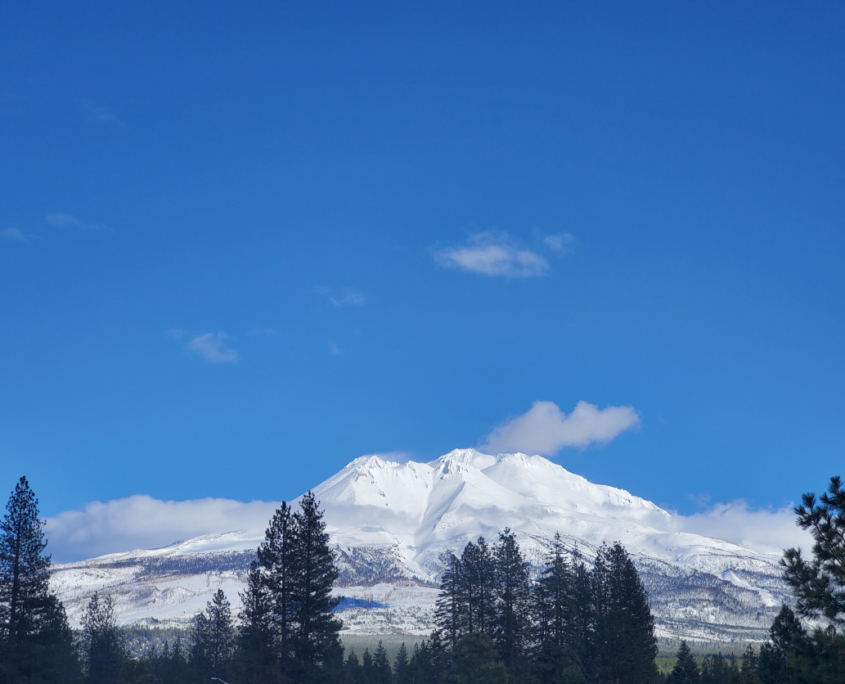
Snow-covered Mount Shasta as viewed from the west with it’s secondary cone, Shastina, in the foreground.
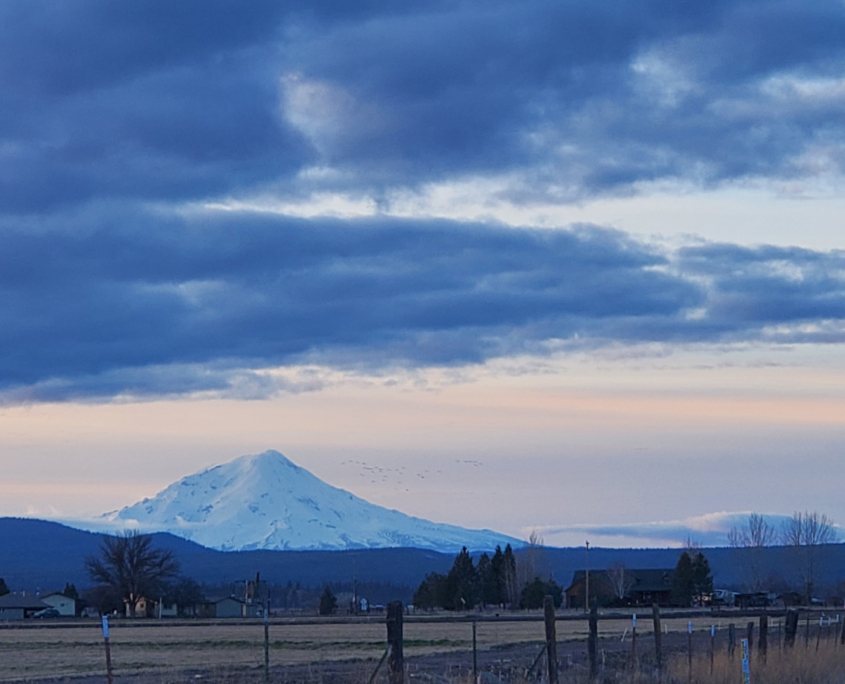
Mount Shasta’s eastern flank, rising above the farmlands of the ‘Big Valley’ near McArthur, CA.
There is a well-documented phenomenon in the careers of artists who return repeatedly to the same landscape: at a certain point, the place stops being a subject and becomes a character. It acquires a quality of particularity — of personality, almost — that transforms the work from depiction into dialogue.
Cézanne returned to Mont Sainte-Victoire more than sixty times across the last decades of his life. The mountain in his late work is not being described. It is being encountered. Each painting is a new meeting between the painter’s perception and something that meets him back — something that has its own presence, its own resistance, its own way of appearing differently on different days and in different light.
Georgia O’Keeffe’s relationship with the New Mexico desert operated similarly. The landscape was not a backdrop for her painting. It was a living participant in it. The bones, the flowers, the sky — these are painted with the specificity of long intimacy, the knowledge that comes only from sustained, repeated presence in a particular place.
Mt. Shasta occupies this position in my own practice.
I have returned to this mountain across many years, in many states of mind and many qualities of light. Each return is a different encounter. The mountain in winter, carrying snow down to the timber line, is a different being from the summer mountain — bare volcanic rock above the treeline, heat rising from the pumice fields. The mountain at dawn is different from the mountain at dusk. The mountain seen from the valley floor is different from the mountain encountered from Panther Meadows, where the treeline ends and the high slopes begin and the sky feels unusually close.
These are not merely visual variations. They are different qualities of presence — different aspects of the same character revealing itself under different conditions. This is what I mean when I speak of the Faces of the mountain. Not faces as masks or surfaces. Faces as the different expressions of a single identity — each one a genuine encounter, each one revealing something that the others do not.
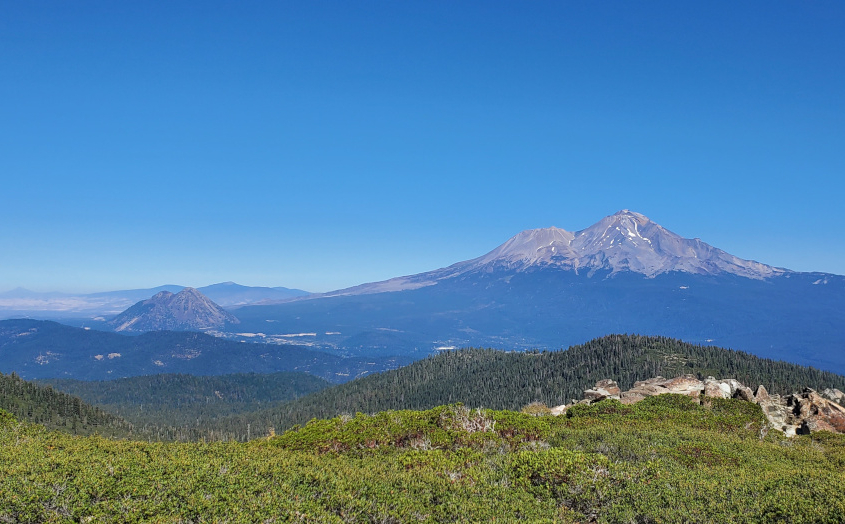
Mount Shasta as viewed from the south west, it’s secondary cone, Shastina to the left. Shasta’s summit is the primary cone and holds the vertical axis of the mountain when viewed from any direction.
There is a physical component of why Mt. Shasta produces the quality of vertical attention it does — a reason rooted in its geometry rather than its mythology, though the two are not unrelated.
Mt. Shasta is a stratovolcano — formed through repeated layers of eruption building up around a central vent. The result is a form unusually close to a symmetrical cone: a shape that converges from a broad base toward a single apex, creating an unambiguous vertical axis along which the eye is drawn upward. Unlike mountains formed by tectonic folding, which tend toward complex ridgelines and multiple summits, a stratovolcano produces a form with a single, clear center of gravity.
What makes this geometry particularly powerful is that it presents a vertical axis from every direction of approach. Whether you encounter Shasta from the north, the east, the northeast — where the main summit rises in its most classic, uninterrupted cone form — or from the south and southwest, where Shastina, the subsidiary cone, creates a beautiful dual-peak rhythm alongside the main summit, the primary vertical axis holds. Shastina reads as a harmonic rather than a disruption — a secondary voice alongside the main one. The mountain cannot be approached from any angle without the vertical being present. The axis is not dependent on perspective. It is intrinsic to the form.
This is geometrically unusual, and it explains something about why the mountain’s effect is so consistent regardless of where you are standing. The surrounding landscape — the relatively flat volcanic plateau, the high desert spreading in every direction — amplifies this further. The contrast between the horizontal ground plane and the sudden, unambiguous vertical of the mountain creates an orientation that is as much physiological as visual. The eye and the body find the axis before the mind names it.
This same principle operates in other landscapes where the axis mundi quality is strongly felt. The Black Hills of South Dakota — sacred to the Lakota and the site of one of the most significant Indigenous place-based spiritual traditions in North America — rise abruptly from the surrounding Great Plains with very little topographic preparation. The hills appear suddenly out of flat grassland, a forested island of vertical form in an ocean of horizontality. The axis mundi effect here is produced not by cone geometry (the geolgy of the Black Hills is different to Mount Shasta,) but by this same radical contrast — the flat and then, without warning, the vertical. The effect on the human being encountering it is strikingly similar: orientation, arrest, a sense of having arrived at a center.
This geometry — convergent, axial, ascending — is the same geometry that appears in the pyramids, the stupas, the Gothic spires, the mandalas of the Tibetan tradition. The axis mundi, in its material expressions across cultures, almost always takes this form: broad at the base, tapering toward the apex, organised around a single vertical axis that rises from the horizontal plane with clarity and without ambiguity. Mt. Shasta is not simply associated with the axis mundi by cultural convention. Its physical form embodies the geometry that the axis mundi symbol is built from.
The form itself — independent of any particular mythology — produces the quality of vertical attention that the axis mundi represents. The geometry does
If all of this is true — if vertical form in the landscape produces a specific and well-documented quality of response, and if that response includes precisely the qualities most needed in spaces designed for healing and inner attention — then landscape painting that genuinely engages this dimension has a different kind of presence in a room than landscape painting that is primarily scenic.
The distinction is not between abstract and representational, or between contemporary and traditional. It is between painting that is oriented toward something archetypal — that carries the vertical invitation of the axis mundi into the room — and painting that depicts a view without engaging the dimension the view opens onto.
In my own practice, the Faces of the Mountain series is an attempt to paint the mountain as a living entity rather than a scenic backdrop — to bring into the work the quality of vertical attention, of genuine encounter with something larger, that the mountain itself produces. The paintings in this series are not identically composed. Each one is shaped by a different quality of encounter — a different face, a different aspect, a different moment of meeting between painter and place.
What they share is the axis: the vertical dimension that the mountain embodies, the sense of upward reach and grounded base, the quality of being oriented along a line that passes through the ordinary and extends toward something beyond it.
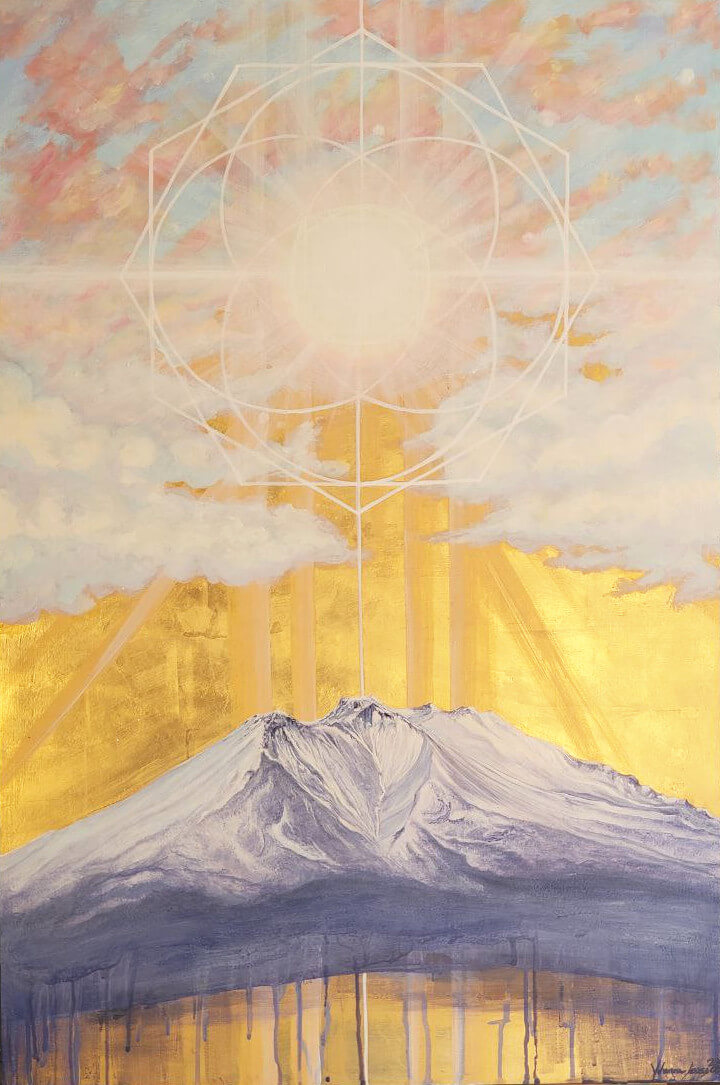
Original painting ‘Heart of the Mountain’ depecting the vertical essence of Mt Shasta
For collectors and practitioners thinking about the art they live with, the question the axis mundi raises is a practical one.
A room has orientation or it doesn’t. The art in it either supports the vertical dimension — the dimension of height, of aspiration, of what the human being reaches toward — or it doesn’t address that dimension at all.
This is not a question about having paintings of mountains in every room. It is a question about whether the art in a space holds something of that quality — the quality that landscape painter and writer Robert Macfarlane calls “the pull of the vertical” — the sense that there is a dimension of experience that extends beyond the horizontal plane of daily life, and that attending to it is part of what makes a life fully lived.
A few things I’ve learned, over years of placing this kind of work in both:
Ceiling height and sightline matter more than wall size. A vertical work reads most powerfully where the room itself already has some upward reach — a peaked ceilng, a double-height entry, a hallway with a stairwell, a wall a person passes and glances up at rather than sits and stares into. In a lower, more intimate room, a vertical piece can still work, but it will read as an invitation rather than a dominant feature — which is often exactly right for a bedroom, a small treatment room, or a private study.
Scale changes what the axis does to the body. A large vertical work in a room where people stand or move through — a lobby, a hallway, a gathering space — tends to produce the more physiological, orienting version of the response, closer to what Keltner and Haidt describe. A smaller vertical work in a room where people sit still for long stretches — a therapy office, a meditation corner, a reading chair — works more quietly, as a point the eye returns to rather than a scale the body responds to.
Placement opposite where people naturally rest their eyes tends to outperform placement behind them. In a waiting room or a healing space especially, this is worth being deliberate about — the axis does its work most powerfully if someone is actually looking toward it.
Plotinus, whose thinking on beauty and the soul we explored in an earlier article in this series, described the ascent toward beauty as a movement upward — from sensible form to intelligible form, from the image to the reality the image points toward. The mountain is one of the most ancient and consistent symbols of that ascent. A painting that genuinely engages the axis mundi carries that invitation into the room where it lives.
But there is a deeper dimension to the axis mundi that the I Ching articulates with particular clarity — one that transforms the mountain from external symbol into internal reality.
In the I Ching, the trigram sometimes rendered as Emperor or Heaven-Earth-Human places the human being not as observer of the vertical axis but as its middle term: heaven above, earth below, and the human being as the mediating principle between them. The human being, in this framework, does not stand at the foot of the mountain looking up. The human being is an axis mundi — the point in creation where earth and heaven meet, where the material and the spiritual interpenetrate, where the below is reached by the above and the above is grounded by the below.
This reframes everything about the awe response to mountains. When Keltner and Haidt describe awe as producing a loosening of self-focused thinking and a sense of being part of something larger — what may actually be happening is something more specific than simple smallness in the face of vastness. The encounter with the mountain as external axis mundi may awaken something of the internal axis mundi — the recognition, in the presence of that vertical form, of one’s own vertical nature. The mountain, as symbol of the mediating principle between heaven and earth, produces recognition of the same principle within the one who encounters it.
This is, again, precisely Plotinus’s word for what beauty does to the soul: recognition. The soul encounters beauty and names it as from an ancient knowledge. The mountain produces recognition of something the soul already is but has perhaps forgotten — the axis, the bridge, the living meeting point between dimensions.
If this is true, then a painting that genuinely holds the axis mundi is not simply a landscape image placed in a room. It is an ongoing invitation — visible in passing, available without effort — to remember one’s own vertical nature. To be briefly reminded that the plane of the ordinary is not all there is, and that the bridge between dimensions is not elsewhere. It is here. It is what we are.
Not as a program. Not as a message. Simply as a quality of vertical presence — a reminder, available in passing, on any given morning, that the pull of the vertical is not the mountain pulling at us from outside. It is the opportunity for something in us, to recognise itself.
The Faces of the Mountain series is an ongoing body of work exploring Mt. Shasta as axis mundi — a place where earth meets sky, and where repeated return reveals a living landscape
 © Yohanna Jessup 2023