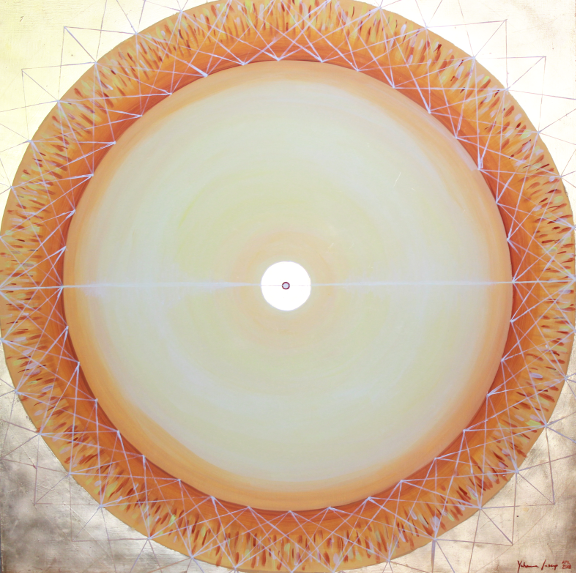
Sol, original painting of the solar principle with a central point, peripheral circumference, and 24k gold leaf. Available as an Atelier print.

Sol, original painting of the solar principle with a central point, peripheral circumference, and 24k gold leaf. Available as an Atelier print.
There’s a feeling certain rooms give you, and others don’t.
You walk in and something in you softens before you’ve consciously registered why. The light feels different — warmer, more alive, more bouyant than the room you just left. You become more present without deciding to. Something in the space has already reached you, before your thinking mind catches up.
I’ve felt this in churches built hundreds of years ago. I’ve felt it in a friend’s living room, and in a single well-placed painting. I’ve felt it in the healing spaces and communal rooms I’ve worked with, too — the ones where a group of people are meant to simply be together.
For years now, in my own studio, I’ve been working with the material I believe embodies that feeling, more than any other: gold leaf.
This isn’t only a material choice for me. It never has been. But it took me a long time to find the language for why — and writing this piece has been part of that finding.
The first thing to understand about gold leaf is that it simply doesn’t act like paint.
Pigment absorbs most of the light that hits it and reflects back only the wavelength we perceive as its color. That relationship is fixed — a red stays red whether it’s morning or evening, whether the light is warm or cool. It doesn’t change its mind.
Gold does something else entirely. It reflects almost all incident light — its reflectivity is among the highest of any naturally occurring substance — but how it reflects shifts constantly with the angle, the quality of the light, the movement of your own eye. A single sheet of gold leaf can read as deep amber from one spot in a room and bright, luminous yellow from another. Across a single day, the same surface can move from bronze at dawn, to brilliant white-gold at midday, to warm copper as the light lowers toward evening.
Which means a painting with real gold leaf in it isn’t a fixed object. It’s a living one. It changes as the room changes. It participates in the light rather than simply receiving it — and that participation is, I think, the foundation of the aliveness people feel standing in front of gilded work.
I keep returning to Rudolf Steiner’s twelve lectures on colour, where he described certain colors as inherently luminous — not colors that merely reflect light, but ones that seem to generate it from within. Gold is the clearest material expression of that idea I know. It isn’t competing with the light in the room. It’s becoming light, the moment light touches it.
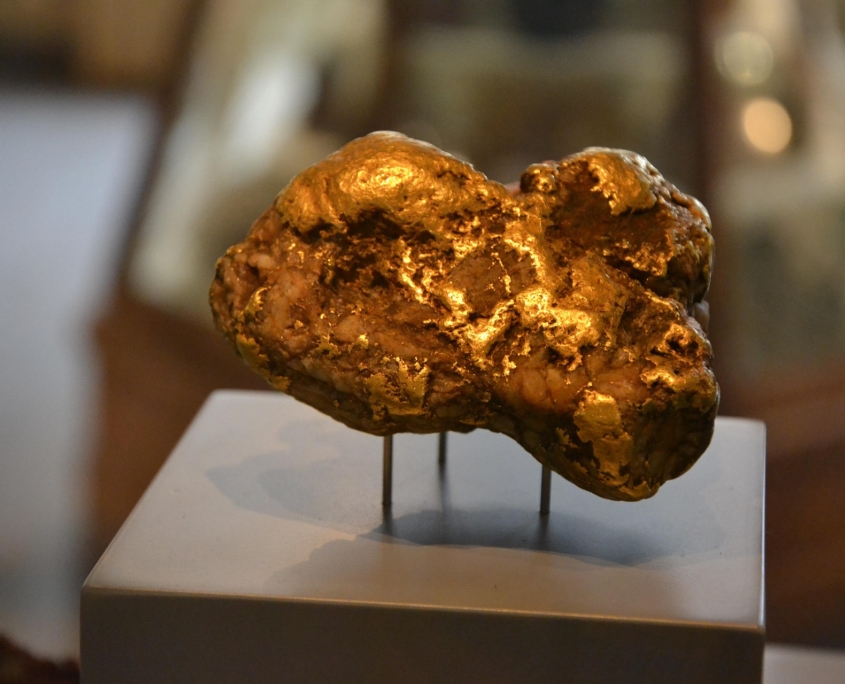
A large nugget of gold in it’s unrefined mineral form.
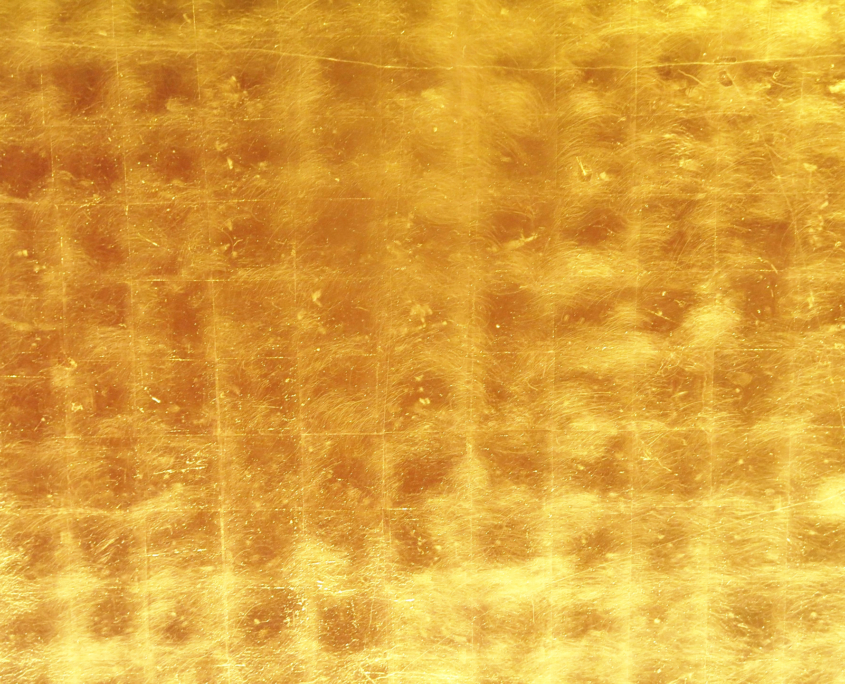
A field of gold leaf with tones from deep amber to light yellow gold depending on the angle of reflection of light.
I want to go a layer deeper than the physics, though, because I don’t think physics is the whole answer to why gold keeps showing up, again and again, across traditions that had no contact with one another.
I’ve been sitting with this question through the lens of the Hermetic tradition — one of the deep roots of the Western esoteric tradition, traditionally traced to Hermes Trismegistus, with roots reaching into ancient Egypt, carried through Greek philosophy, preserved by Arab scholars through the centuries when Europe had largely forgotten it, and returned to the West after the Crusades. In this tradition, astrology and alchemy were never separate disciplines. Every planet had a corresponding metal, a psychological quality, a whole constellation of symbolic association — different octaves of a single underlying archetype.
 The Sun and gold shared one symbol: a circle with a single point at its center. The circle stood for the totality of creation. The point stood for its source — the center without which the whole circle would collapse in on itself. Gold wasn’t linked to the Sun by convention or by taste. It was understood as the Sun’s presence made material: something that doesn’t tarnish, that produces its own brilliance rather than borrowing it, that functions as an anchor point for whatever it sits within.
My teacher, Samuel Sagan, writes about this at length in “Planetary Forces, Alchemy and Healing“. In his account, the Sun isn’t simply a star. It’s the archetype of the center — the creative principle without which nothing else can exist, giver of both life and light, the point every mandala organizes itself around. A principle of ongoing generation that is continually fed and supported from its source.
In astrology the sun planetary force has two modes — the higher mode, and the lower mode. On the higher mode the sun represents the capital ‘E’ Ego — the higher self, the spark of the divine in the individual, the part of us that Christian mystics have called Christ consciousness, that doesn’t rise and fall with mood or circumstance. The lower mode sun is the little ‘e’ ego. The little ego is the personality, full of likes and dislikes, reactions and moods. Gold, as the Sun’s metal, carries the same pointer. Depending on how it is used, it can reflect either the lower mode (bling, gilded ornamentation that is obnoxious) or the higher mode, where it isn’t about ego in the ordinary sense at all. Symbolically it’s a material reflection of the divine in matter.
I find something structurally similar in Carl Jung, writing centuries after the height of alchemical practice. Jung read the alchemists’ pursuit of gold not as a literal chemical operation but as a symbolic record of the psyche organizing itself around what he called the Self — a center distinct from the little ‘e’ ego, the point individuation moves toward. Different vocabulary, same recognition.
This, I think, is why traditions with no contact with each other — Byzantine iconographers, Japanese temple builders, Tibetan thangka painters, medieval European workshops — kept arriving at the same material. If gold functions as a genuine symbolic and perceptual center, its recurrence isn’t coincidence. It’s convergent recognition of something inherent to the archetype behind the material itself.

A 15th-century icon of Christ Pantokrator, Byzantine and Christian Museum of Athens.
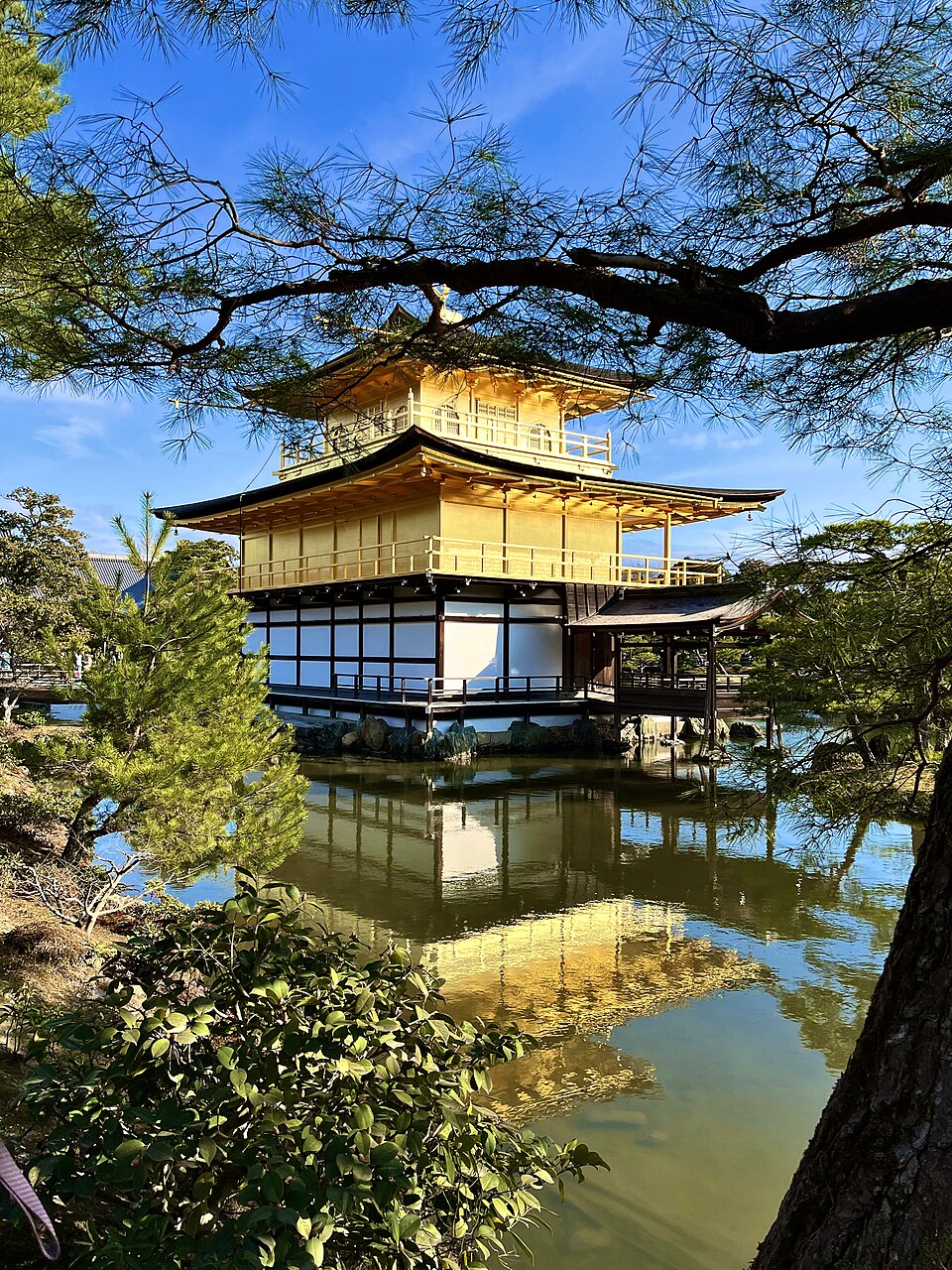
Kinkaku-ji, the Golden Pavilion, Kyoto. Covered in gold leaf so the building appears to float above its own reflection.
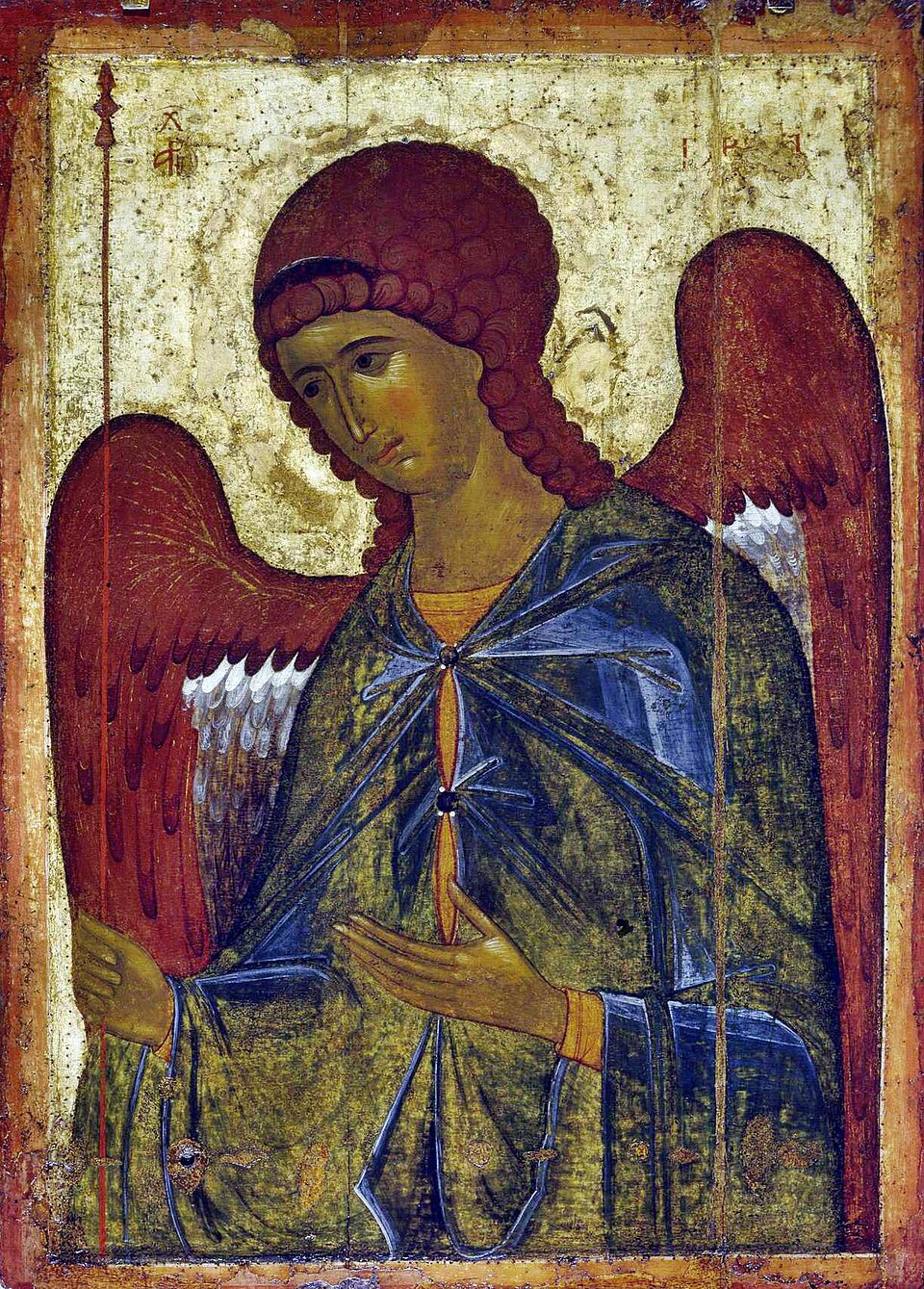
Archangel Gabriel, from the Vysotsky Deesis tier (Moscow, 1387–1395), Tretyakov Gallery. Painted in the Palaeologan style at the height of Byzantine artistic influence in Russia

A 15th-century Tibetan thangka depicting Je Tsongkhapa, founder of the Gelug school of Tibetan Buddhism, now in the Rubin Museum of Himalayan Art.
Once you start looking, gold shows up in almost every tradition that built spaces for healing, worship, and reflective practice.
Byzantine icons used gold grounds not as background, but as the divine light the figures exist within. When candlelight moves across a room full of gold-grounded icons, the boundary between material and immaterial starts to feel genuinely uncertain, and the veils between the physical and non-physical seem to become thinner. That uncertainty wasn’t an accident. It was the point — the gold was doing theological work, holding the spaces imbued in the icons by the meditative practices of their creators.
Kinkaku-ji, the Golden Pavilion in Kyoto, was covered in gold leaf so the building would appear to float above its own reflection in the pond below it — detached from its material setting, hovering between earth and sky. I’ve read visitors describe a quality of suspended attention when they encounter it, even without any of the original religious context — a sense of being briefly outside ordinary time.
Medieval altarpieces, from Cimabue and Duccio through the early Renaissance, used gold grounds as a shared convention: this surface exists in a different order of reality than the figures painted on it. Nobody thought paradise actually had a yellow background. The gold was a signal of the divine, understood by everyone who looked at it.
Tibetan thangka paintings use gold for the same underlying reason — to mark what’s depicted as belonging to a luminous rather than material realm, supporting the meditative use of the image.
Across every one of these traditions, gold does something pigment simply cannot: it creates the sense that light is emanating from within the surface, rather than merely bouncing off it.
I don’t only think about this in the context of grand historic spaces. I think about it in the context of your home — the room where you wake up each morning, the wall behind your desk, the corner where you go to let your nervous system settle at the end of a day. Your daily meditation space. I think about it just as much in the healing and communal spaces I’ve worked with — rooms where a group of people gather to slow down, practice, or heal together, and where the quality of the environment shapes the quality of what happens in it.
The design field already treats light — natural light access, lighting quality, illumination in patient and practice areas — as a real factor in how people experience a space; it’s a standard part of evidence-based design thinking at this point. What I don’t think gets talked about enough is the contribution of surfaces themselves, and art in particular, to the felt quality of light in a room.
A painting with real gold leaf introduces something into that room that responds to its light. As clouds pass, as the afternoon shifts into evening, the gold in the piece shifts with it. It creates a quiet animation in the space — a sense that the room itself is alive and responsive — entirely different from what a flat, pigmented surface can offer.
This isn’t dramatic. It doesn’t compete for your attention. It works at the edge of what you consciously notice — felt more in its absence than its presence, but shaping the quality of a room continuously all the same.
People often describe this to me without knowing quite what they’re describing. “The room feels warmer in the afternoon.” “That painting never quite looks the same twice.” These aren’t just poetic observations. Your eye is genuinely detecting real variation in the work’s luminosity as the light changes — and that variation registers, somewhere beneath conscious thought, as vitality. As life. As presence. In a space meant to support healing or reflection, where people return to the same room again and again, I don’t think that’s a minor thing. A painting that participates actively in a room’s light is a different kind of object than one that simply occupies a position on the wall.
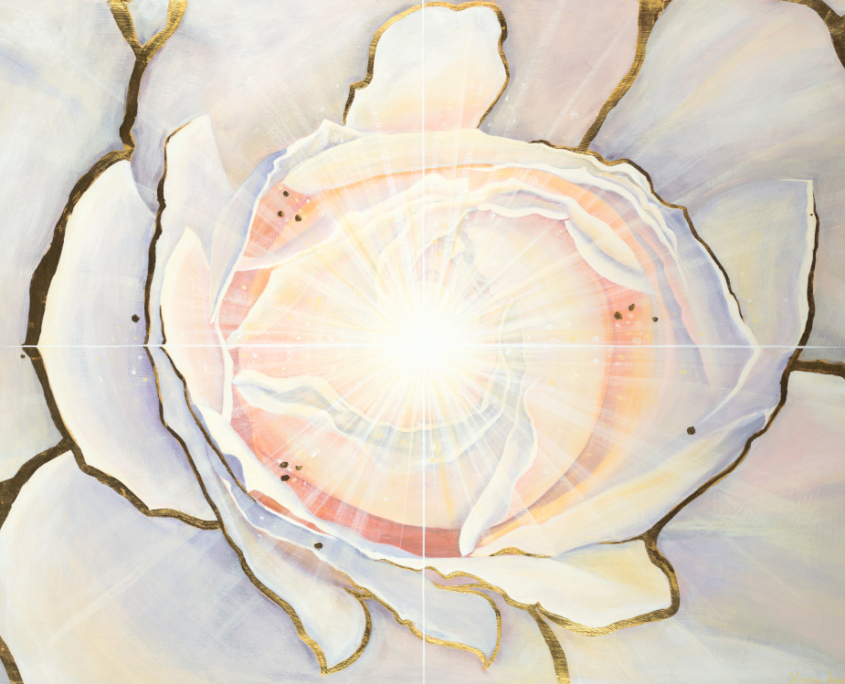
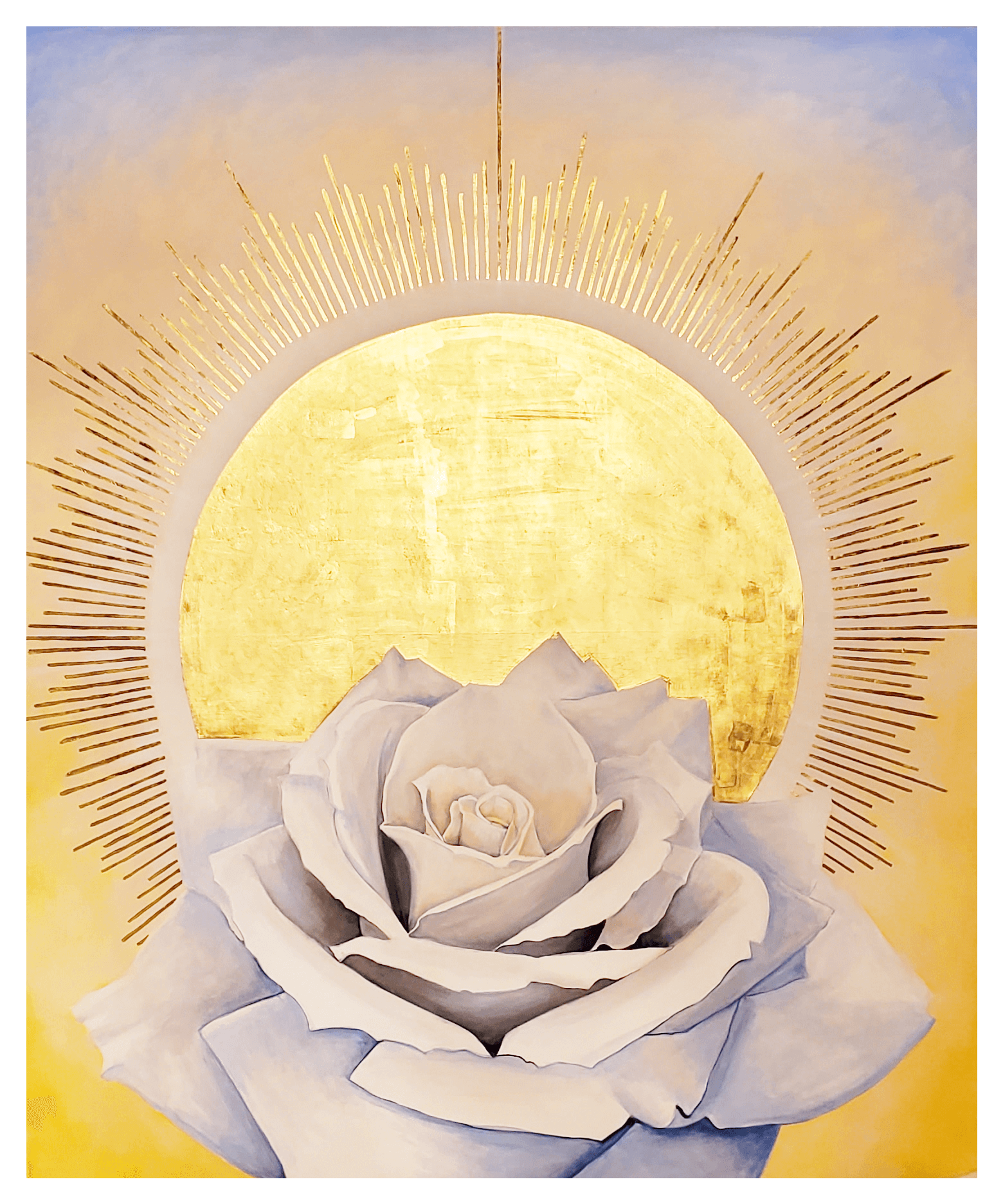
Open Spirit Rose print before gilding. The photographic reproduction of the gold is a bit flat.
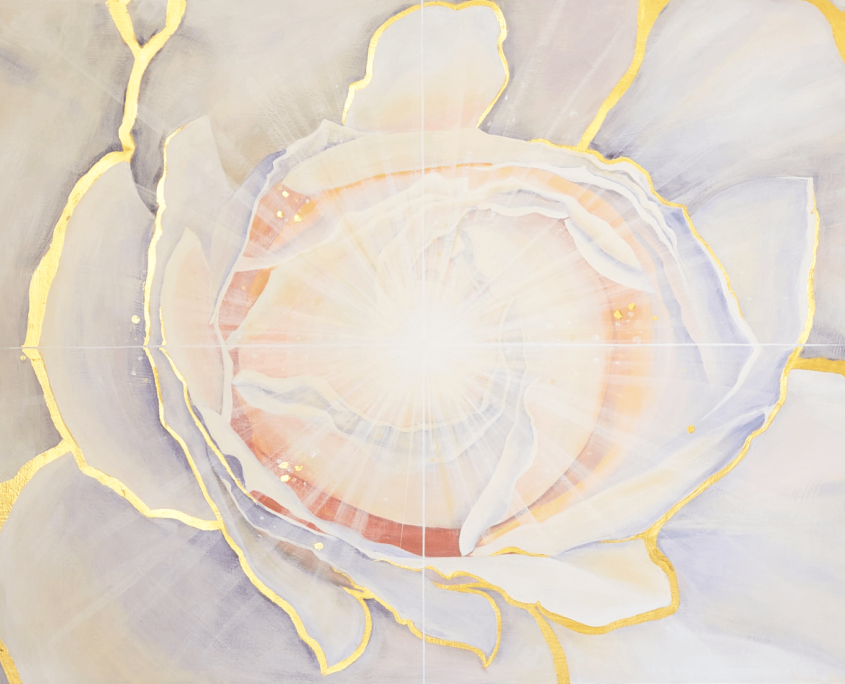
Open Spirit Rose print after gilding. The luminosity of the surface carries greater aliveness and presence.
This is also where the conversation about originals versus prints becomes unavoidable — because gold leaf, in its living, responsive form, cannot be reproduced.
A print shows you the color of the gold at one particular moment, in one particular light, from one particular angle. It’s a photograph of a single instant in the life of a surface that is, in the original, always changing. What a print can’t carry is that responsiveness — the very quality that gives the original its aliveness. This is one of the clearest practical arguments I know for originals in spaces where the art will be encountered daily, whether that’s a home or a healing environment: the reproduction is static, the original is not.
This is part of why my Atelier and Lux editions exist. When I hand-gild a print, or return to work paint back into it for a Lux piece, I’m not trying to fake what only the original can do. I’m bringing back a piece of it — enough that the print becomes something closer to its own small original, rather than simply a copy standing in for one. High-quality prints absolutely still have their place, particularly in secondary placements — but if you’re living with one, the question worth asking is a little different: does this piece appear to *generate* light, or only to absorb it? Paintings with a strong sense of inner luminosity — where the light seems to come from within the composition, not fall on it from outside — hold their presence in a room far longer than paintings that handle light conventionally, gold leaf or not.
If you’re considering a piece with significant gold leaf for your own space — or specifying one for a space you’re designing or overseeing — a few things I’ve learned over years of working with this material:
Natural light placement matters more than people expect. A gold-leafed piece in direct, raking light at certain hours can be extraordinary — or, depending on the angle, a little distracting. North-facing walls, with their steady diffuse light, tend to give the most reliably beautiful relationship between the gold and the room. East-facing walls create striking morning effects. West-facing walls come alive in the afternoon.
Gold responds to its own market, separate from everything else in a piece. Unlike pigment, gold is priced at commodity rate. For commissions with significant gold leaf, I quote that portion separately from my fee, so you can see clearly what you’re investing in and why.
How much gold, and where, changes the whole feeling of a piece. A painting that’s predominantly gold turns the gold into atmosphere. Gold used as an anchor or ground beneath other elements creates depth, a sense of luminosity beneath the surface. Gold as accent or detail creates specific, smaller moments of light within a larger composition. Each does something different to a room.
Not all gold is equal, and it’s worth asking. Genuine 24k gold leaf never needs sealing — pure gold simply doesn’t tarnish, and with the water-soluble wax paint I work in, sealing varnishes wouldn’t be compatible with the surface anyway. Properly applied 24k leaf has survived centuries in Byzantine and medieval paintings without any deterioration. Gold acrylic paint and metallic powder are not the same material, and they don’t age the same way. If gold matters to you in a piece you’re considering or commissioning, it’s worth simply asking whether it’s genuine leaf.
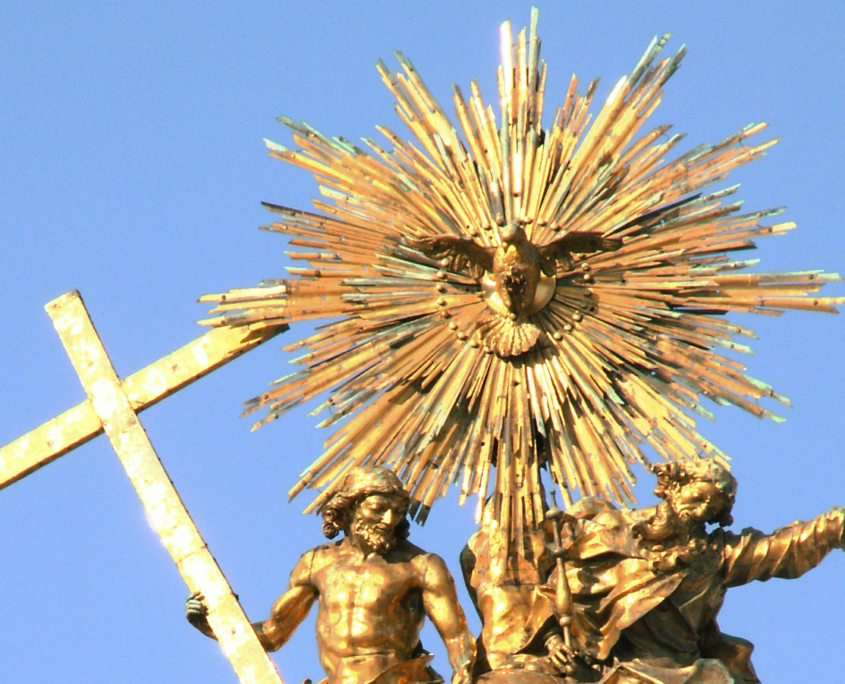
The gilded Holy Trinity group crowning the Holy Trinity Column in Olomouc (1716–1754), a UNESCO World Heritage site.

The Sun’s corona in ultraviolet light, captured by ESA/NASA’s Solar Orbiter on 9 March 2025 — a composite of 200 individual images, the widest high-resolution view of the Sun ever taken.
ESA & NASA/Solar Orbiter/EUI Team; Data processing: E. Kraaikamp (ROB)
There’s a passage in Plotinus — written in the third century, long before anyone had the materials science to explain it — describing what beauty does to the soul that meets it: it enters into unison with it. The soul recognizes beauty as something it already knows, and in that recognition, something in it comes alive.
I think gold leaf does something structurally similar, in a room. It creates a surface in continuous relationship with its environment — never quite the same as it was an hour ago, changing with the day, participating in the space it inhabits rather than merely occupying it.
That’s the same recognition the Hermetic tradition located in the Sun and its metal, in a different vocabulary: not simply an aesthetic preference for brightness, but an intuition — arrived at independently, across centuries and continents — that certain materials function as centers. As anchors. As the point everything else in a room can quietly organize around.
I feel this every time I lay gold into a piece in the studio. It isn’t only a material decision. It’s an anchor — a place where presence can land and settle more fully than it does in the paint around it. I return to certain works later, specifically to work gold into them by hand, because there’s a quality it holds that nothing else in my materials quite replicates.
A room that holds this kind of surface isn’t simply well-decorated, and it isn’t simply healing-adjacent. It’s inhabited by something more than inert material. It dances with the light of the moment, and creates a luminous spaciousness — breathing a touch of the infinite into everyday existence, whether that existence is lived alone at a desk or shared in a room full of people trying to settle into themselves together.
 © Yohanna Jessup 2023Lotus Sanctuary & Heart of the Mountain: The September Lux Editions