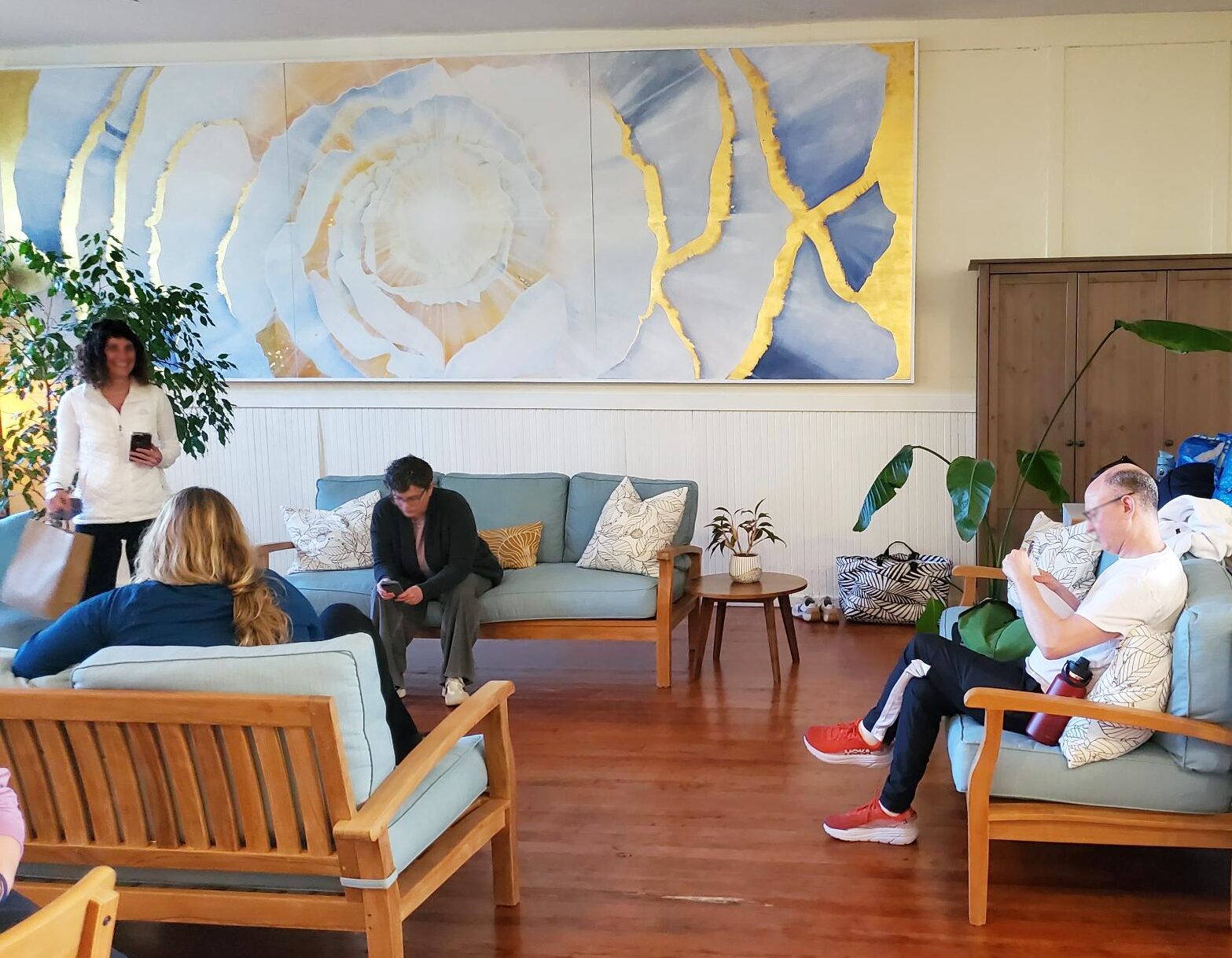
‘Peace Rose’ a large scale painting resides in the community area of a Berkeley meditation center.

‘Peace Rose’ a large scale painting resides in the community area of a Berkeley meditation center.
For centuries, artists, mystics, and philosophers have understood beauty not as decoration, but as something transformative — an experience that touches us, awakens us, and subtly alters our inner state.
Only recently has science begun to explore this territory with language and tools of its own. Neuroscience is now offering evidence for what spiritual traditions, artists, and contemplatives have long known through direct experience: beauty affects us at the level of the nervous system, the brain, and our sense of meaning and well‑being.
This emerging field is called ‘neuroaesthetics’ and it may be one of the most important conversations unfolding about art, beauty, and human flourishing.
Neuroaesthetics is a branch of neuroscience that studies how the brain responds to aesthetic experience — especially visual art, beauty, music, creativity, and design.
It asks questions such as:
Early research suggests that aesthetic experience activates networks in the brain associated with reward, meaning, emotional regulation, and connection. In other words, beauty is not optional to human experience — it appears to be essential.
We live in a culture that often prioritizes productivity over presence, speed over depth, and information over meaning. In this context, beauty is frequently treated as a luxury — something extra, ornamental, or indulgent.
Neuroaesthetics quietly challenges this assumption.
Studies now suggest that engaging with visual art can:
Beauty, it turns out, is not merely pleasing. It is regulating.
One of the most intriguing insights from neuroscience is that the brain does not treat beauty as a superficial stimulus.
When something is experienced as beautiful, the brain activates networks related to:
Beauty wakes us up from within.
Some researchers suggest that humans evolved to respond to beauty because it guided us toward what was life‑supporting — fresh water, safe environments, healthy bodies, harmony in nature. In this sense, aesthetics may function as a deep evolutionary language.
If beauty affects the nervous system and brain, then the art we live with — not just what we encounter occasionally in museums — becomes part of our internal landscape.
The walls around us are not neutral.
They shape mood, attention, emotional tone, and the felt experience of daily life.
This brings us back to something artists have always known:
Art is not passive. It is relational.
It interacts with us over time. It invites reflection, steadies attention, and offers a quiet place for the nervous system to organize itself.
In the 3rd century, the Neoplatonic philosopher Plotinus wrote that beauty was not merely about pleasing form, but about revealing a deeper order — harmony, coherence, and truth.
For Plotinus, beauty elevated the soul because it reminded us, often wordlessly, of our own inner nature. He believed that beauty draws us upward toward what is more unified, more essential, and more real.
Art, in this view, was not something to consume — it was a doorway.
It is striking how closely this ancient understanding aligns with contemporary neuroscience. Both suggest that beauty does not simply change what we see — it changes who we are in that moment.
For thousands of years, beauty and sacred art were used intentionally to create sacred space in temples, sanctuaries, meditation halls, and healing spaces.
These environments were not only visually pleasing — they were designed to create connection, inspire wonder, awe, and orient awareness towards the inner world, stillness and coherence.
Today, fields such as neuroaesthetics, environmental psychology, and evidence‑based design are beginning to confirm what earlier cultures understood intuitively:
In many ways, science is not discovering something new — it is remembering something ancient.
Science may describe the effects of beauty in the body, but it does not explain its source. That question — where beauty comes from, and why it moves us — remains open.
Beauty does not decorate life; it deepens it.
When we encounter beauty — in nature, art, architecture, or moments of quiet — the breath softens, attention steadies, and something in us remembers itself.
Beauty is a form of nourishment.
And art is one of the oldest ways humans have practiced it.
When you bring meaningful art into your home, you are not simply decorating a space. You are shaping the environment your nervous system lives inside every day.
You are creating a sanctuary for attention, emotion, and inner life.
Beauty works through relationship — through repetition, presence, and time. It meets us differently on different days, in different seasons of life, offering continuity and depth.
Perhaps neuroaesthetics is not revealing something entirely new.
Perhaps it is giving contemporary language to a timeless truth: that beauty is a bridge — between the visible and the invisible, the brain and the heart, the human and the sacred.
Plotinus believed beauty led the soul home.
Neuroscience now suggests beauty may also lead us back to regulation, meaning, and wholeness.
Art, in this sense, is not an object.
It is a relationship.
If you’d like to explore the science and philosophy of beauty more deeply, here are a few wonderful places to begin:
Your Brain on Art: The Case for Neuroaesthetics – an accessible introduction to how aesthetic experience changes the brain and supports well-being.
https://www.jneurosci.org/content/44/44/e1833242024
The International Arts + Mind Lab (Johns Hopkins) – leading research on creativity, healing, and neuroscience.
https://www.artsandmindlab.org/impact-thinking/
Penn Center for Neuroaesthetics – current studies exploring how art and beauty shape emotion, stress, and meaning.
https://neuroaesthetics.med.upenn.edu
The Cognitive Neuroscience of Aesthetic Experience – foundational research defining the brain processes involved in beauty.
https://pubmed.ncbi.nlm.nih.gov/26993278/
The Enneads by Plotinus – a timeless philosophical exploration of beauty as a path to the soul.
https://classics.mit.edu/Plotinus/enneads.html
Some other resources:
Editorial: Possible applications of neuroaesthetics to normal and pathological behaviour
https://pmc.ncbi.nlm.nih.gov/articles/PMC10381953/




 ©YohannaJessup2017Creation